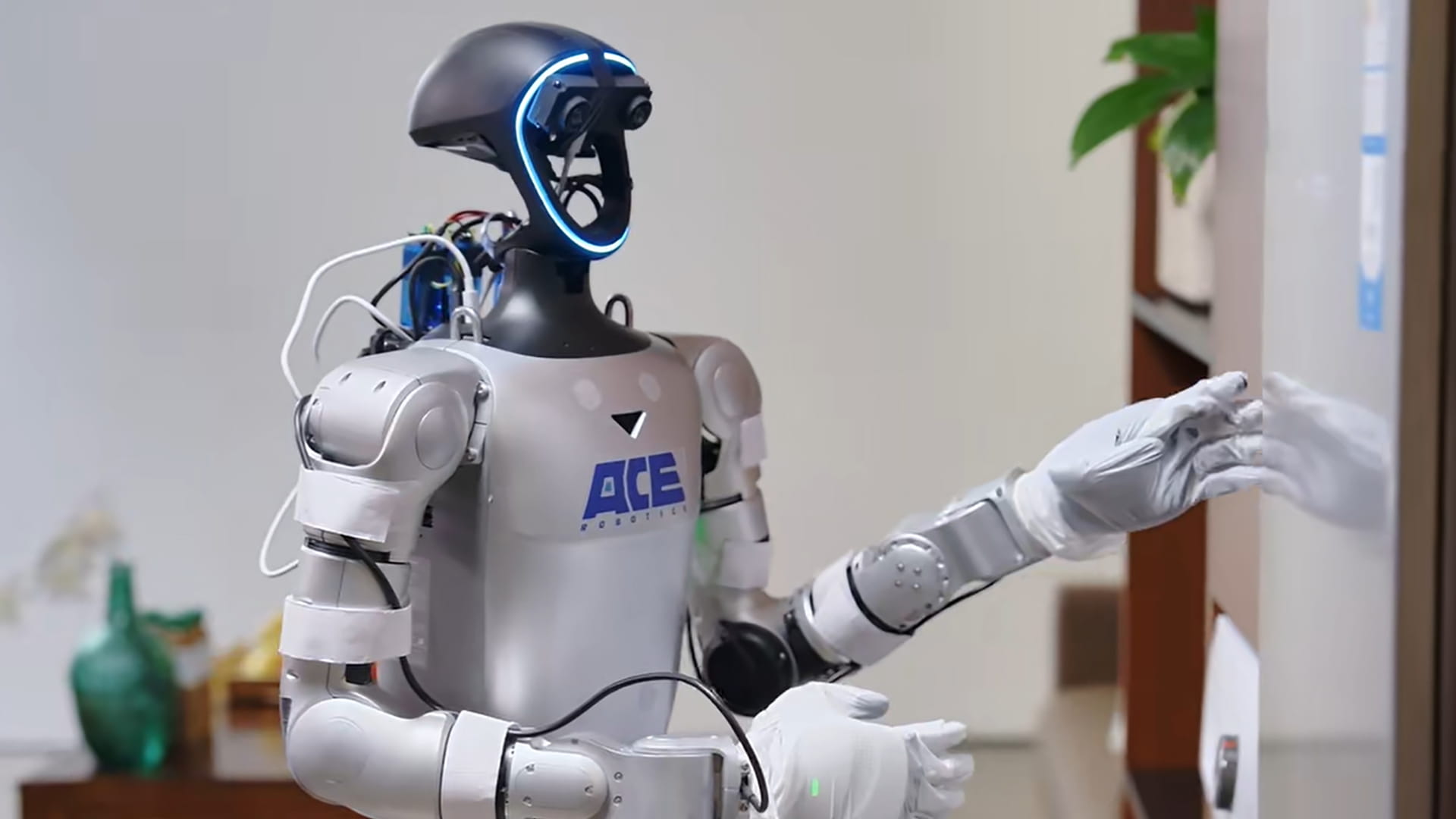
The embodied intelligence sector, which is the trade press shorthand for AI systems that operate through physical robot bodies rather than through screens, has been one of the hottest categories in the Chinese venture market for the past eighteen months. Founders with pedigrees from Huawei, Tsinghua, and Tesla have raised capital at valuations that have compressed the traditional venture cycle from years to months. Foundation model companies, world model developers, and hardware manufacturers are all racing to establish position. The Western trade press has been covering the category primarily through the lens of Figure and Tesla's Optimus, which are the two Western humanoid robotics programmes that receive the most attention. The Chinese side of the same category is moving faster, deploying earlier, and attracting more capital, but the coverage in the English-language press has not yet caught up.
ACE Robotics is the case study that most clearly illustrates what has actually changed. The company was founded in July 2025 by Wang Xiaogang, one of the co-founders of SenseTime. That biographical detail matters. SenseTime is one of the largest AI companies in China. Wang's earlier career had established him as one of the country's most respected computer vision researchers before he moved into applied AI. When he founded ACE Robotics, he was not entering the embodied intelligence sector as a first-time founder. He was entering it with the operational credibility, the investor network, and the customer relationships that come from a decade of building one of China's most valuable AI companies. ACE Robotics has accumulated a nine-figure USD sum in cumulative 2026 financing and reached unicorn status faster than almost any embodied intelligence company in the country.
The strategic framing Wang articulated to the Chinese trade press is the part the Southeast Asian operator should be reading. World models alone will not solve robotics' deployment problem. That statement is important because it contradicts the direction most Western investment is currently pointing. Western AI investors have been organising around the thesis that the foundation model is the bottleneck. If you build a sufficiently capable world model, the robotics deployment follows. Wang argues that framing is incomplete. Foundation model companies, world model companies, and data companies are each building their own data collection plans, but in the future, robot bodies will be driven by data, not by rules from real machines or physical models. That means the actual deployment problem is a systems integration problem. How do you collect data from humans. What data should be collected to drive the robot hardware body. How should the robot hardware body be designed to meet the requirements of human behaviour. If the hardware design is too complex, humans cannot perform the corresponding actions during data collection, and there will be no data in the future to drive the robot body.
The systems problem is what Figure and Tesla are solving through vertical integration. Both companies build the models, the data, and the hardware internally. The internal iteration is more efficient because the three components can be co-designed. The Chinese embodied intelligence sector has not yet formed the equivalent vertical integration. Robot body companies remain cautious about scenario deployment because of technological immaturity and pressure from resource investment. Upstream data collection standards have not been unified. The supply of high-quality data that can be used directly for embodied model training remains insufficient. Hardware iteration cycles are far longer than model cycles, making design difficult to coordinate. Wang's strategy at ACE Robotics is to identify scalable deployment scenarios and robot body manufacturers with which the company can work deeply, treating scenario partnerships as the vehicle for solving the systems integration problem that vertical integration solves for Figure and Tesla.
The Editor's Note
If you are reading this and the pattern fits your business, start the conversation before the conversation starts itself. editor@unpublished.my.
The deployment sequence is worth studying. ACE Robotics started with road inspection using quadruped robots. It has now expanded into hotels, unmanned retail stores, and unmanned logistics warehouses. The next phase is more complex consumer home scenarios with higher safety requirements. The sequencing follows a specific logic. Business-to-business scenarios have controlled conditions and can ensure safety. Consumer scenarios have weak rule boundaries and contain many unstructured environments. So ACE Robotics accumulates operational experience in B2B settings before moving toward B2C. The methodology matches what Wang calls the human-centered environmental data collection approach. Instead of relying only on humans teleoperating robots, the company collects human interactions with real environments at scale. This has reportedly expanded the world model training data to one million hours, ten times the volume of traditional real-robot data collection.
The scenario selection discipline is the piece the Malaysian operator should be studying most carefully. Wang articulated it directly. ACE Robotics prioritises retail and warehousing because their business systems and needs can be replicated nationwide. Hotels are also a replicable scenario. There are many hotels across the country, and what the company delivers is the same set of inspection, navigation robot, and quadruped robot systems. That replicability constraint is the strategic filter. A scenario that requires custom development for each deployment produces linear scaling economics. A scenario that produces a replicable solution produces compounding scaling economics. ACE Robotics has consciously chosen to deploy only in scenarios where the solution replicates. That discipline is the difference between a robotics company that scales into a durable business and one that becomes a bespoke systems integrator.
For the Malaysian and broader Southeast Asian operator, four implications run from this story.
One. The scenario selection discipline is the transferable strategic principle. Any Malaysian company considering deploying robotics (industrial automation, hospitality, retail, logistics, security) should be evaluating its target scenarios against the replicability test. If solving the deployment problem for the first customer produces a solution that transfers to the next twenty customers with minimal customisation, the scenario is worth pursuing. If it does not, the scenario is a bespoke consulting engagement, not a business. Most Malaysian operators currently evaluating robotics investments are not applying this filter rigorously. The operators who apply it will produce structurally different business outcomes than the operators who do not.
Two. The B2B before B2C sequence is the risk-managed path to consumer robotics. ACE Robotics is deliberately deploying in controlled business environments before attempting consumer home scenarios. The Malaysian operator considering consumer robotics deployment (elder care, domestic assistance, education) should be studying the sequencing rather than the destination. The companies that skip the B2B accumulation phase and try to deploy directly into consumer scenarios face safety, liability, and reliability challenges that the vertically integrated Western competitors have the capital to absorb but that most Southeast Asian operators do not.
Three. The industrial partnership model is the ecosystem position. Wang's framing is that industrial partners are the entry point into the embodied intelligence industry because they have scenarios. Data collection for those partners is a business that monetises immediately. Malaysian industrial groups (Sime Darby Plantation for agriculture, Genting for hospitality, YTL for utilities, Petronas for energy) all have scenarios that could support embodied intelligence deployment partnerships with companies like ACE Robotics or its regional equivalents. The industrial groups that structure these partnerships now, on favourable data-ownership and capability-transfer terms, will position themselves as the ASEAN reference deployments for the category. The industrial groups that wait will pay premium terms to catch up.
Four. The Southeast Asian sovereign investors should be studying the ACE Robotics investor list. Fortune Capital, Shenzhen Capital Group, Shanghai Sci-Tech Innovation Center Capital, MetaX, Sharewin, Fosun RZ Capital, Tsinghua Holdings Capital, Lingang New Area Fund, and SenseCapital participated in the most recent round. That investor mix (state-linked venture capital, university-affiliated funds, industrial groups, and strategic corporate investors) is the template for how China is capitalising the category. Khazanah, PNB, EPF, and the various Malaysian state-linked investment vehicles should be evaluating whether the Malaysian sovereign investment ecosystem is currently structured to participate in the equivalent regional deployments. If the answer is no, the structural work to build that participation capability is the highest-return investment Malaysian sovereign capital could make in 2026.
The headline is a Chinese robotics unicorn twelve months after founding. The story is that the embodied intelligence sector has moved past the technical validation phase and into a systems integration and scenario deployment phase, where the winners will be companies with scenario partnerships and replicable solutions rather than companies with the largest models. The Malaysian operator who reads the Kairos 3.0 benchmark scores is reading the wrong version. The right version asks which specific Malaysian scenarios are replicable, which industrial partners can support the deployment, and what sovereign capital structure would need to exist to make the ASEAN reference deployments happen in Malaysia rather than in Singapore or Indonesia.