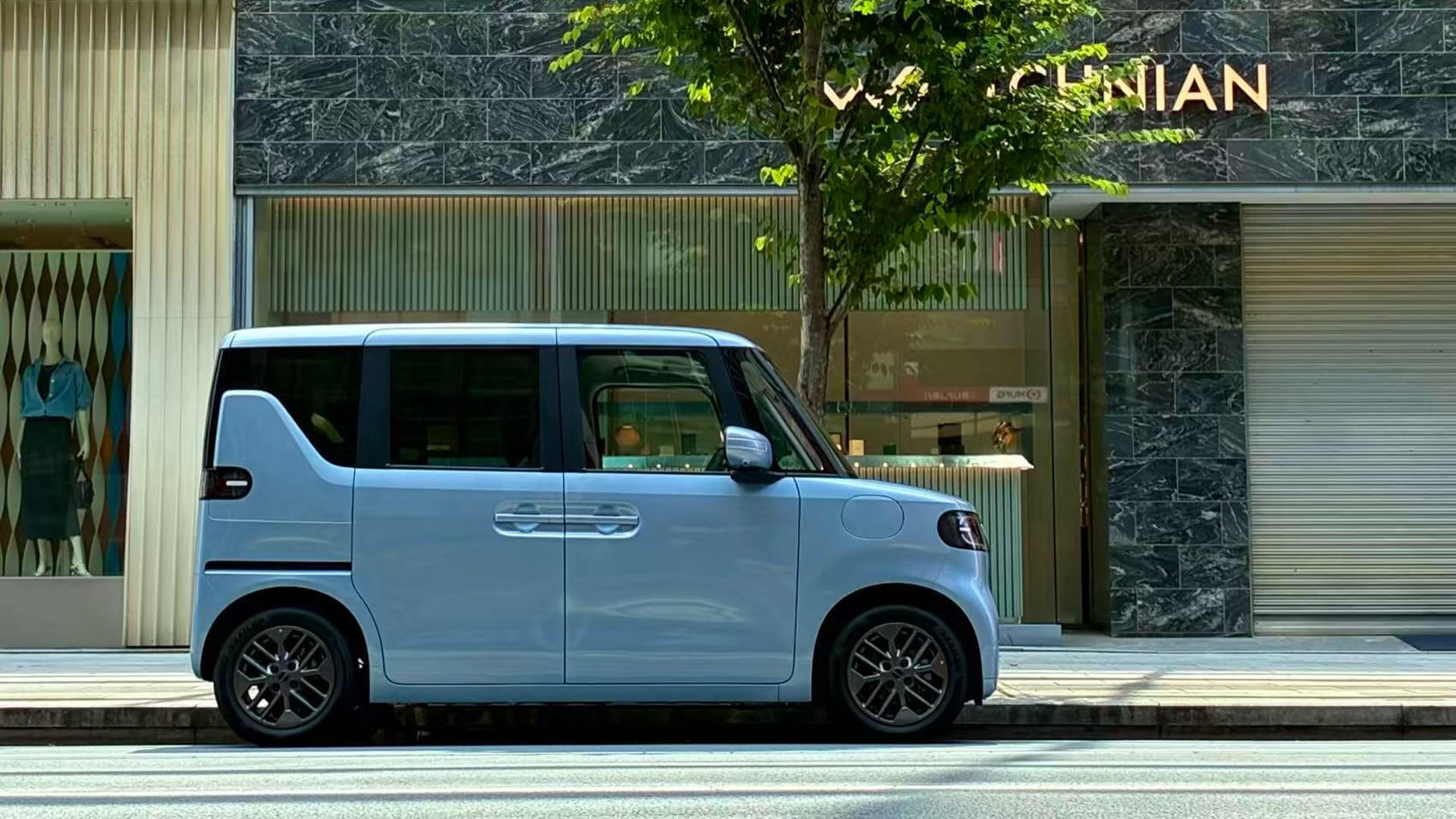
The Japanese automotive market is one of the hardest export destinations in the world for any non-Japanese automaker. The country's tight regulatory framework, dense supplier ecosystem, and consumer preference for domestic brands have historically produced import share well below the levels seen in almost any other developed market. Chinese automakers entering Japan have consistently discovered that the export playbooks that work in Southeast Asia, the Middle East, and Latin America do not translate. BYD has spent the past three years testing that discovery in real time. The company's cumulative Japanese sales through June 2026 stood at 2,223 vehicles, against Nissan's 24,750 units of the Sakura kei EV in the same period. The gap is not marginal. It is roughly one order of magnitude.
BYD's response is the Racco, a purpose-built kei-class electric vehicle that will debut in Japan in October. Kei cars, or minicars, are a Japanese regulatory category defined by tight dimensional limits (roughly 3.4 metres long and 1.48 metres wide) and engine displacement caps. The category exists because Japan's postwar urban planning produced dense residential neighbourhoods with narrow streets that larger vehicles cannot navigate practically. Kei cars represent about 30 percent of all vehicles in Japan and up to 60 percent in some rural prefectures. That specific regulatory and consumer context is what makes kei cars a distinct market segment rather than simply a small-vehicle sub-category.
The Racco is BYD's first vehicle engineered specifically to the Japanese kei regulatory dimensions. Every previous BYD model sold in Japan (the Dolphin, the Atto 3, the Seal) was a Chinese-market design lightly adapted for export. The Racco represents a different level of commitment. Purpose-building a kei-class vehicle requires engineering investment that only makes sense if the manufacturer intends to build durable Japanese market position. BYD said the Racco is the result of research it conducted after entering the Japanese market three years ago, including data collected through customer surveys and interviews. The company has confirmed the Racco will be sold in Japan later this year and priced under Nissan's Sakura, which currently retails between JPY 2.5 million (about USD 17,000) and JPY 3.1 million (about USD 21,000).
The strategic move that deserves closer reading than the trade press has provided is BYD's decision to sell the Racco primarily to rural and suburban Japanese buyers rather than to metropolitan Tokyo. That specific decision is the difference between a scale entry strategy and a differentiation entry strategy. Nissan's Sakura currently dominates the Tokyo metropolitan kei EV market. Entering Tokyo head-on would require BYD to convince Japanese urban consumers to buy a Chinese-branded vehicle against the domestic incumbent in the incumbent's strongest geography. That specific competitive dynamic favours the incumbent, and BYD has explicitly chosen not to fight it. Instead, BYD is targeting the rural and suburban Japanese kei market, where kei penetration is much higher than in Tokyo, where consumer brand preferences are less locked in, and where the incumbent's marketing investment is proportionally lower per addressable customer.
The Editor's Note
If you are reading this and the pattern fits your business, start the conversation before the conversation starts itself. editor@unpublished.my.
The dealer network strategy underneath the Racco launch reveals additional strategic discipline. BYD has been building its Japanese dealer network deliberately, opening 76 outlets to date with plans to reach 100 by year-end 2026. The company is offering models from the compact Dolphin to the flagship Seal, plus a Toyota Alphard-style minivan, spanning the entire consumer vehicle price band. The Racco extends that portfolio into the specific kei segment that has been structurally excluded from BYD's Japanese offering until now. Once the Racco is added, BYD will be positioned as a full-line Japanese-market automaker with a specific product for each of the major consumer vehicle segments. That specific portfolio breadth is what allows BYD to build durable dealer economics, because each dealer can serve every consumer segment rather than depending on demand for a single flagship model.
The domestic Chinese context matters here because it explains why BYD is investing so much in Japanese market entry. China's domestic NEV market has grown at breakneck speed for the past five years, but the growth rate is inevitably slowing as domestic penetration approaches saturation. NEV penetration in China reached 62 percent in July 2026. That specific penetration level implies domestic growth will increasingly come from replacement demand rather than net new adoption. Chinese NEV manufacturers have a specific strategic incentive to build durable international operating positions before the domestic growth rate compresses further. BYD's Japanese entry is one of several international commitments the company is making simultaneously. Reading BYD's Racco as a Japanese story is directionally correct. Reading it as one piece of a coordinated global market entry strategy is more accurate.
For the Malaysian and broader Southeast Asian operator, four implications run from this story.
One. The Malaysian automaker export strategy should be studied against the BYD entry discipline. Proton and Perodua have both articulated overseas expansion ambitions over the past decade. The specific market entry pattern that has consistently produced better results across the Asian automotive category is the pattern BYD is executing in Japan: identify a specific consumer segment the incumbent has structurally under-served, purpose-build a vehicle for that segment, and enter with a portfolio breadth that supports durable dealer economics. The default Malaysian automaker export pattern of competing head-on with the regional Toyota or Honda position in the mid-sized segment has produced almost no durable overseas position for either domestic automaker.
Two. The Malaysian automotive component supplier has a specific opportunity to qualify into BYD's Japanese vehicle supplier network. BYD's Racco is being produced with a Japan-specific supplier ecosystem. Malaysian automotive component suppliers that can meet Japanese quality certification standards represent a specific export opportunity that is not currently being pursued at the required scale. The qualification cycle is long and expensive, but the resulting supplier position gives Malaysian operators exposure to BYD's global purchasing that other regional suppliers cannot easily match.
Three. The Malaysian NEV policy framework should be evaluated against Japan's specific kei-class regulatory model. Japan's kei category demonstrates that a regulatory framework can create a specific vehicle segment that would not exist in an unregulated market, and that segment can become the primary vehicle category for rural and suburban consumers. Malaysia's NEV policy framework currently does not include a specific low-cost, low-displacement, urban-appropriate vehicle category that would serve equivalent Malaysian rural and suburban demand. Designing that specific regulatory category would produce Malaysian NEV adoption patterns that generic NEV incentives cannot achieve.
Four. The Malaysian rural mobility operator should be reading the kei-class positioning as a specific commercial opportunity. Malaysia's rural and suburban populations have transport mobility needs that current mainstream vehicle categories serve inadequately. A specifically-designed low-cost electric vehicle for Malaysian rural mobility, produced under a regulatory framework equivalent to Japan's kei category, would represent a specific Malaysian domestic manufacturing and operating opportunity. That opportunity has not yet been pursued at the required strategic depth by any Malaysian automotive operator.
The headline is a Chinese automaker launching a Japan-specific vehicle. The story is the specific market entry discipline underneath the product launch, which produces meaningfully better durable market position than the default export strategies most non-Japanese automakers have historically pursued in Japan. The Malaysian automotive operator who reads the Racco as a BYD story is reading the wrong version. The right version asks which specific market entry disciplines from the BYD playbook can be applied to Malaysia's own overseas automotive expansion, and to Malaysia's domestic NEV policy framework, over the next thirty-six months.