The autonomous driving sector has spent the past three years in a phase the trade press has been calling technical validation. Whether the technology works. Whether the safety record holds. Whether the software can handle the corner cases. Those questions are being answered. The sector is now moving into commercial rollout at scale, which is a completely different set of questions. Whether the unit economics work. Whether the operational infrastructure exists. Whether the customer acquisition, service dispatch, vehicle maintenance, and fleet management systems can support a business model rather than a demonstration.
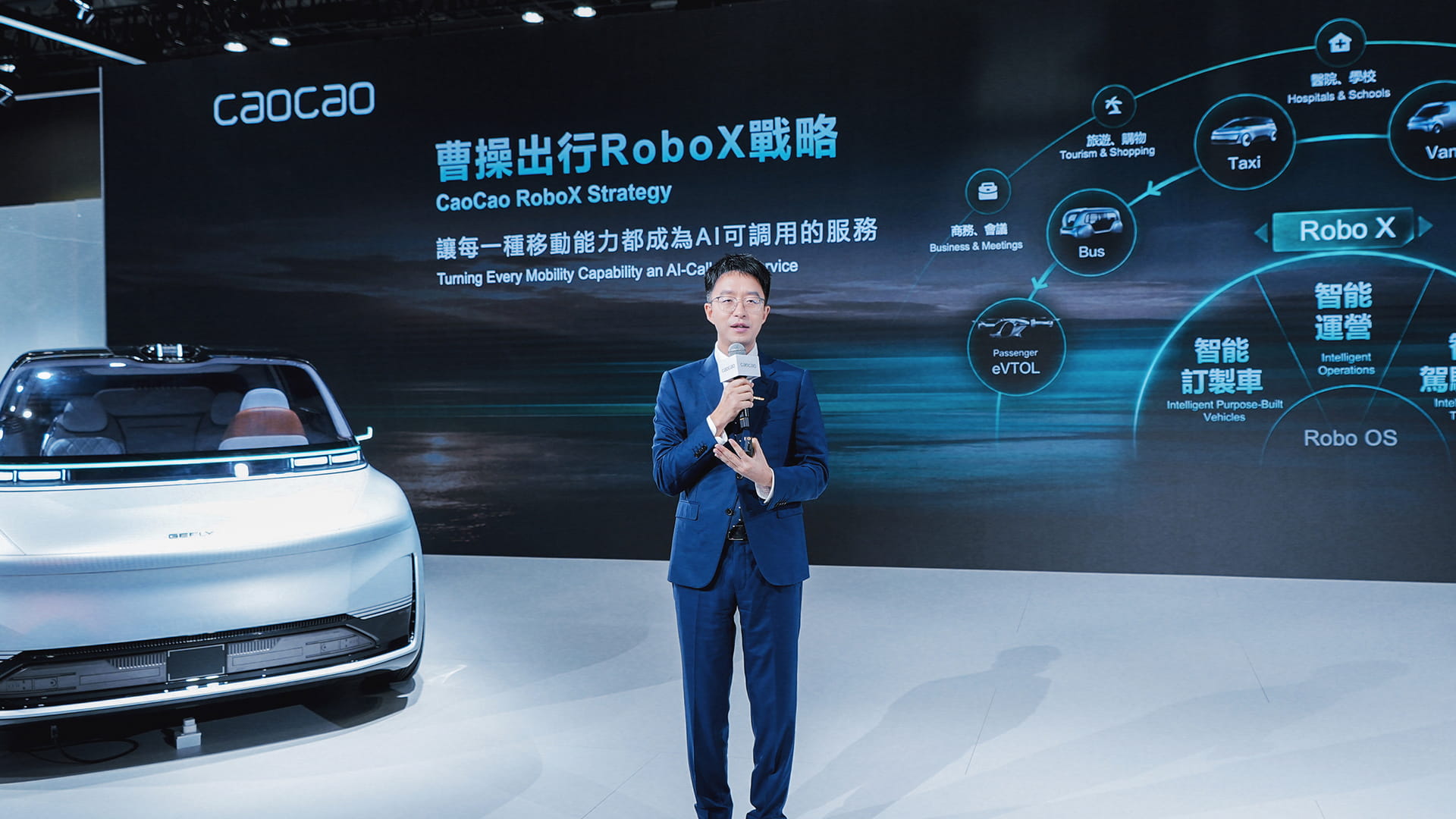
CaoCao Mobility, the Geely-backed Chinese ride-hailing operator, released its answer to those questions on June 30. The strategy is called RoboX. The framing is not modest. RoboX is designed as a system-wide upgrade across products, technology, and operations, with the company planning to expand from robotaxis into robovans, robobuses, and robotrucks. The autonomous driving stack is targeting Level 4 capability, which means vehicles operating without human intervention under defined conditions. The operating system is introducing what the company calls an AI-driven brain, connecting demand forecasting, supply matching, and service fulfillment. The target for 2030 is 100,000 robotaxis and 100,000 robovans in operation.
CaoCao's chief executive Gong Xin articulated the strategic frame with unusual precision. What CaoCao Mobility wants to do is not fight to become the entry point. No matter which entry point users come through, they can use RoboX to enjoy smart ride-hailing, delivery, and even low-altitude mobility services. Read that framing carefully. The company is explicitly declining to compete for the user-facing entry point (the app, the interface, the brand) that Grab, Didi, Uber, Bolt, and every other consumer ride-hailing platform is fighting over. CaoCao is instead positioning as the operating layer underneath the user-facing platforms, providing the vehicles, the dispatch, the driverless capability, and the operational orchestration that any consumer platform can plug into. That is the position that would make CaoCao a vendor to Grab, Didi, and every other consumer platform simultaneously, rather than a direct competitor to any of them.
The operational data underneath the strategy is what makes it credible. CaoCao's average monthly active users reached 41.3 million in 2025. The company completed more than 1.9 billion mobility services that year. Its road condition coverage spans complex urban roads, extreme weather, morning and evening rush hours, and unusual road conditions across a nationwide operating footprint. The mobility network covers 195 cities. The company has eleven years of shared mobility operating experience. Compare that operational base to the autonomous driving startups that are currently competing for the same category. Most of them have a fraction of the operating history, a fraction of the geographic coverage, and a fraction of the real-world driving data. CaoCao's bet is that Level 4 autonomous driving does not improve through larger algorithmic models alone. It requires continuous iteration using real-world scenario data. And the company with the largest real-world scenario data set is structurally best positioned to iterate that model fastest.
The purpose-built vehicle is the piece the trade press has been undercovering. CaoCao spent five to six years developing a robotaxi model designed from the start for autonomous driving and shared mobility. The vehicle has a dedicated spatial layout, safety configurations, and intelligent interaction features. It supports battery swapping. It has a longer theoretical service life than ordinary passenger cars because it is engineered for the operational cycle of a shared mobility fleet rather than for the ownership cycle of a private car. As Gong put it, what exactly is the difference between an operating vehicle and a private car? These are not questions that can be resolved in a day or two. The answer, developed over five to six years, is that the operating vehicle has different requirements in nearly every dimension, and that these requirements compound over time into a materially different vehicle. CaoCao has built the answer. The strategy is to extend the customisation capability from robotaxis to robovans through a partnership with Farizon Auto, then to robobuses, then to robotrucks. Each vehicle category is designed for the operating economics of that specific use case rather than adapted from a consumer vehicle platform.
The Editor's Note
If you are reading this and the pattern fits your business, start the conversation before the conversation starts itself. editor@unpublished.my.
The AI-integrated operating system is the layer that determines whether the strategy scales profitably. Gong framed it precisely. In driverless mobility, asset operation capabilities determine the gap between companies' business performance. Driverless vehicles will become corporate assets. How you make these assets safer, deliver a better experience, and achieve the highest operating efficiency and lowest cost depends not only on intelligent driving and vehicle manufacturing, but also on maintenance, cleaning, preparation, quality inspection, and the other unglamorous processes that a mobility operation actually runs on. CaoCao's new AI operating system is designed to coordinate and dispatch different categories of driverless mobility capacity, dynamically adjusting distribution based on urban passenger flows, road conditions, and order demand. It addresses the specific operational problems (idle driverless vehicles, mismatched capacity, delayed responses) that any autonomous mobility operation runs into once it moves past the demonstration phase.
For the Malaysian and broader Southeast Asian operator, four implications run from this story.
One. The category is now bifurcating between operating platforms and consumer-facing apps. CaoCao is deliberately positioning as an operating platform. Grab is positioning as a consumer-facing app. Both positions are strategically credible, and both produce durable businesses at scale. The Malaysian mobility operator's strategic question is not which side of the bifurcation to be on. The strategic question is which specific capabilities to build, buy, or partner for. Prasarana and the Ministry of Transport should be evaluating whether Malaysian mobility infrastructure would benefit more from investing in Malaysian consumer-facing platforms (competing with Grab in market share) or from investing in Malaysian operating platform capabilities (dispatch, fleet management, vehicle customisation, maintenance operations) that could serve multiple consumer platforms simultaneously. The second position is less visible commercially but produces higher structural returns.
Two. The vehicle customisation strategy is the operational lesson most transferable to Malaysian operators. CaoCao spent five to six years figuring out what an operating vehicle actually needs that a private car does not. The lessons are portable. Any Malaysian mobility operator planning to convert a fleet to shared or autonomous operation should be studying the CaoCao vehicle design specifications in detail. The differences (battery swapping architecture, in-cabin durability, operational service intervals, safety configuration for repeat users, intelligent interaction features designed for strangers rather than owners) are specific and measurable. The Malaysian operator who tries to adapt consumer vehicles to shared operations will produce worse economics than the operator who invests in properly customised vehicles from the beginning. Proton, Perodua, and the various Malaysian coachbuilders could position themselves as the customisation partners for this category if the strategic decision is made now.
Three. The 100,000 robotaxi and 100,000 robovan target for 2030 is the numeric commitment the trade press should be pricing carefully. CaoCao is a public company (listed in Hong Kong) making a public commitment to hitting a specific scale by a specific date. That commitment structurally shapes the company's capital deployment, hiring, and partnership decisions over the next four years. The Southeast Asian mobility operators who want to partner with CaoCao during this scale-up phase have a window that is currently open and will start to close as the company signs its priority partnerships. Malaysian, Singaporean, Thai, and Indonesian operators who approach CaoCao now, with clear proposals for regional deployment partnerships, will operate on different terms than the operators who approach later. The window for shaping favourable terms is measured in months, not years.
Four. The infrastructure investment implication is the piece the Ministry of Works and the state road transport departments should be studying. RoboX-scale deployments require infrastructure that most Southeast Asian road networks do not currently have. Battery swapping stations. Autonomous vehicle depots. Dedicated pickup and dropoff zones. Digital road signage compatible with autonomous vehicle sensors. The infrastructure decisions being made now, in the next generation of road planning across Klang Valley, Iskandar, and the northern corridor, will determine whether Malaysia is ready to receive the RoboX-scale deployment when it arrives, or whether the country will need to retrofit at higher cost after the fact. The right infrastructure decisions are relatively cheap when made proactively and expensive when made reactively. The choice being made now is which position the country ends up in.
The headline is a Chinese ride-hailing operator announcing a five-year strategy. The story is the demonstration that the autonomous mobility category is now large enough, capital-intensive enough, and structurally durable enough for a company to publicly commit to hitting 200,000 driverless vehicles by 2030 and to be believed by the trade press. That commitment reshapes the competitive dynamics of the entire regional mobility category. The Malaysian operator who reads the press release version is reading the wrong version.