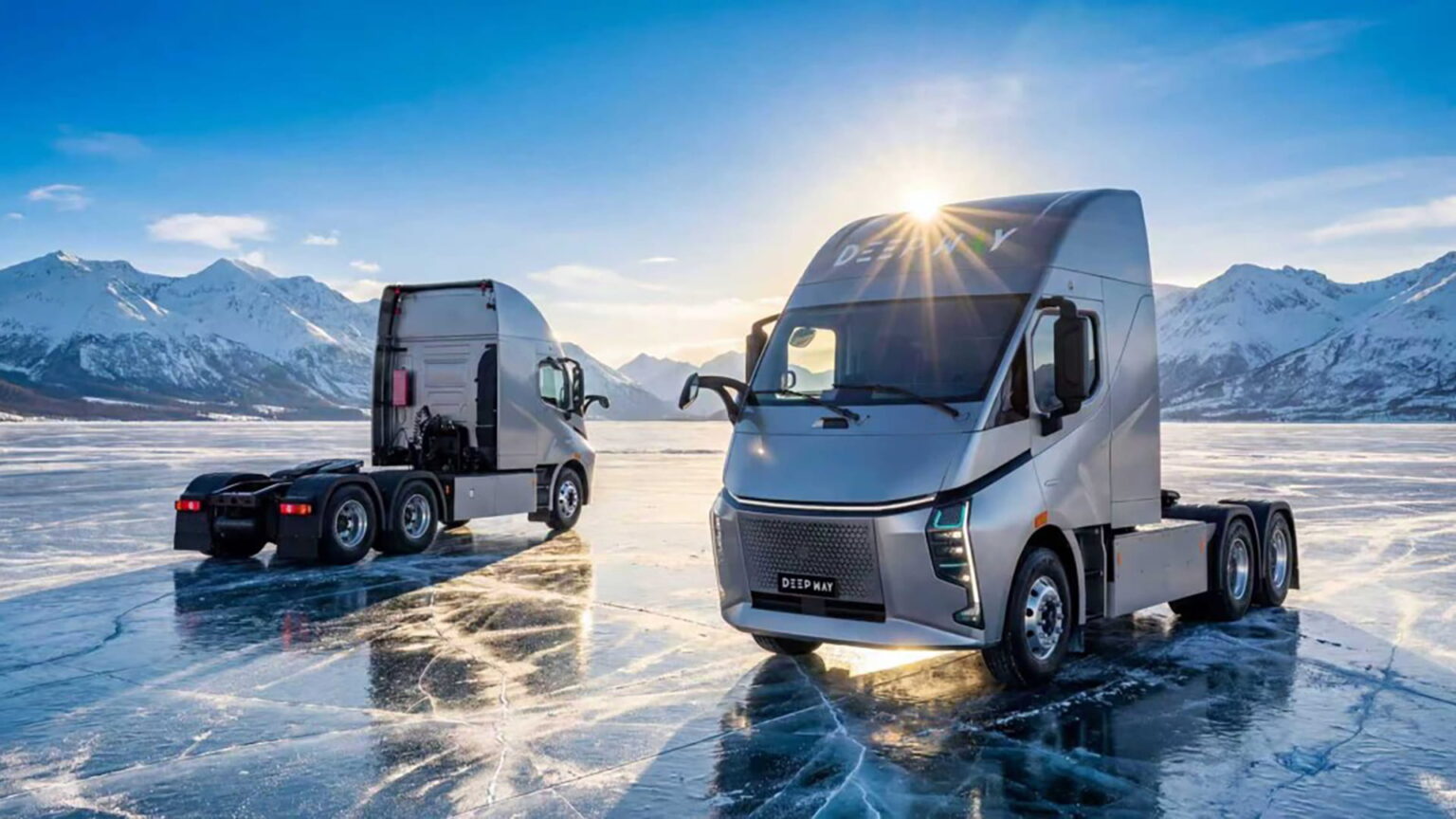
The specific commercial challenge of entering the European heavy-duty electric truck market in 2026 is worth reading precisely because it predicts how Chinese technology-forward operators will approach every major regulated market over the next five years. The European Union is actively deliberating whether to expand its anti-subsidy duties on Chinese passenger electric vehicles to cover heavy-duty electric trucks, on the specific argument that Chinese state subsidies allow Chinese EV manufacturers to sell their vehicles in Europe at prices that European manufacturers cannot competitively match. That specific regulatory risk makes the straightforward export model (ship complete trucks from China to Europe and sell through dealers) commercially fragile over the medium term. DeepWay, the Baidu-backed Chinese electric truck startup founded in 2020 as a joint venture with Chinese logistics firm Lionbridge Group, is entering Europe via a specifically different three-mode strategy that the Malaysian logistics operator should be reading closely.
Zhao Minyu, general manager of DeepWay's international business unit and the company's director of strategy and product planning, articulated the three entry modes at the IAA Transportation trade show in Hanover. The first mode is the straightforward export of complete trucks, subject to the European tariffs that may expand to cover the heavy-duty segment. The second mode is partnering with a local European manufacturer to produce DeepWay trucks on European soil, which materially reduces the tariff exposure and gives the operator access to local supply chains. The third mode is the specifically innovative one: licensing DeepWay's EV and Level 2 human-assisted autonomous driving technology to an established local European brand, which lets DeepWay monetise its technology development investment without needing to establish its own manufacturing or sales infrastructure in Europe. The specific commercial logic Zhao articulated is that as a new, agile, tech-focused company, DeepWay's success depends on integrating into the local business environment rather than relying purely on product superiority. That specific operating philosophy is the one that Malaysian logistics and automotive operators should be studying.
The specific company fundamentals underneath the European entry strategy are worth reading precisely because they explain why DeepWay has the technology leverage to execute a licensing-based entry model. The company reported 2025 revenue of RMB 3.96 billion (approximately USD 589 million), although it has yet to turn a profit. By April 2026, DeepWay had sold more than 13,000 trucks. More than 7,500 of those trucks were equipped with the company's Level 2 assisted-driving technology. Some of the assisted driving trucks are deployed in Inner Mongolia and Xinjiang, where the operational environment (long-haul routes, consistent weather conditions, lower traffic density) is specifically suitable for assisted driving system refinement. After two successful pre-IPO funding rounds in 2026, DeepWay's backer list includes United Arab Emirates sovereign vehicle Stone Capital, Temasek-backed private equity firm ABC Impact, Australian pension fund NGS Super, and Chinese computer maker Lenovo. The company submitted a draft IPO prospectus to the Hong Kong Stock Exchange in May 2026.
The founding commercial logic underneath DeepWay's technology platform is worth reading precisely because it explains why the European manufacturers would consider licensing from a Chinese startup rather than developing equivalent technology internally. DeepWay was founded on the recognition that most electric trucks in China at that time were retrofits of existing diesel truck platforms, which produced specifically unsuitable configurations for autonomous driving integration. Batteries mounted behind the cabin raised the center of gravity and reduced vehicle stability. Many of those batteries also had insufficient range for commercial logistics applications. DeepWay chose to design from scratch an electric truck platform with a low chassis to maintain high-speed stability, integrated with drive-by-wire technology that allows quicker reactions in autonomous control, and equipped with an aerodynamic design for energy efficiency. By the end of 2024, DeepWay was manufacturing the entire powertrain for its second-generation truck, including battery, e-axle, and power electronics, which gave the company full ownership of design. The two DeepWay models showcased at IAA Hanover can travel 350 kilometres and 400 kilometres respectively on one charge.
The Editor's Note
If you are reading this and the pattern fits your business, start the conversation before the conversation starts itself. editor@unpublished.my.
The specific vertical integration logic is worth articulating because it explains the strategic positioning Zhao described. Facing much larger Chinese competitors that leveraged scale for lower pricing and having weaker supplier negotiating power (including in battery procurement), DeepWay chose vertical integration specifically to control core technology rather than compete on price. Rather than aiming directly for Level 4 (fully autonomous) operation, which the company considered a money-burning path for startups, DeepWay launched with Level 2 autonomy to sell to real customers, gather real-world data, and iteratively train and refine Level 4 systems. The specific commercial consequence is that DeepWay generates revenue while reducing reliance on investor funding, which is a specifically different operating model from the venture-funded autonomous driving operators (Pony.ai, WeRide, Waymo) that depend on continued capital raises to extend runway while chasing Level 4 capability. The vertical integration also means DeepWay owns the technology stack that it is now proposing to license to European manufacturers, which gives the licensing commercial conversation a specific credibility that a technology licensing conversation from a less-integrated operator would not have.
The specific regional expansion sequencing is also worth reading precisely because it indicates how DeepWay thinks about market selection. In early 2025, the company expanded to Southeast Asia, the Middle East, Australia and New Zealand (markets with less entrenched local automotive industries where the straightforward export model works commercially). The European entry announced at IAA Hanover is the next phase, targeting a specifically harder regulated market with the three-mode strategy. Due to licensing restrictions in China, DeepWay does not own manufacturing plants domestically and instead uses contract manufacturers (with a primary partner in Shandong). The specific operational discipline that comes from running a contract-manufacturing model in China transfers directly to the licensing conversation in Europe, because DeepWay already has the organisational experience of working with external manufacturers to produce vehicles to its specifications.
For the Malaysian and broader Southeast Asian operator, four implications run from this story.
One. The Malaysian logistics operator (Yinson Holdings, MISC Berhad, Konsortium Transnasional, Tasco Berhad, Pos Logistics, Century Logistics, GDex, Teleport, Lalamove Malaysia, and the various family-owned and government-linked logistics operators) should be reading DeepWay's Southeast Asian expansion as the specific signal that the operator is actively seeking Malaysian fleet partnerships. The specific commercial move is to establish direct contact with DeepWay's Southeast Asian expansion team now, before Indonesian and Thai logistics operators lock in the reference regional partnership terms. Malaysian fleet operators that establish early partnerships will secure materially better commercial terms than operators that engage later.
Two. The Malaysian automotive manufacturer (Proton, Perodua, DRB-Hicom Automotive) should be reading DeepWay's licensing model as a specific commercial template for how a Malaysian automaker could enter the European or North American heavy-duty truck market without the capital commitment required to build its own manufacturing presence in those geographies. The specific operational discipline (develop the full technology stack vertically, then license it to established local manufacturers in target geographies) is a specifically transferable commercial pattern that Malaysian automakers have not seriously evaluated at the strategic level.
Three. The Malaysian NEV charging infrastructure operator (TNB Electron, Gentari, ChargEV, EV Connection, and the various independent charging network operators) should be reading DeepWay's regional expansion as a specific signal that commercial truck charging infrastructure demand is coming to Malaysia within the next 24 to 36 months. The specific operational implication is that commercial truck charging infrastructure has materially different specifications from passenger vehicle charging (higher power delivery, different connector standards, different site layout requirements). Charging operators that build dedicated commercial truck charging capacity now, specifically along the North-South Expressway corridor between Johor Bahru and Penang, will capture the demand as DeepWay and equivalent Chinese electric truck operators extend their regional fleet deployments into Malaysia.
Four. The Malaysian port and logistics hub operator (Westports Malaysia, Northport, Port of Tanjung Pelepas, Johor Port, and the various inland port operators) should be reading DeepWay's integrated powertrain and autonomous driving capability as a specific signal about how the next generation of port-to-warehouse heavy-duty vehicle operations will be structured. The specific commercial implication is that port operators that establish early operational partnerships with autonomous truck operators like DeepWay will be positioned to offer their shipping customers specifically differentiated supply chain services (autonomous drayage, 24-hour operation without driver cost, reduced emissions through battery-electric propulsion) that competing regional ports cannot match without equivalent operational partnerships.
The headline is a Baidu-backed Chinese electric truck startup entering Europe. The story is the specific three-mode entry strategy (export, local manufacturing partnership, technology licensing) that predicts how Chinese technology-forward operators will approach every major regulated market over the next five years, and the specific commercial opportunities the entry strategy creates for Malaysian logistics operators, automakers, charging infrastructure operators, and port operators. The Malaysian operator who reads DeepWay's IAA Hanover announcement as a European truck story is reading the wrong version. The right version asks which specific commercial conversations with DeepWay need to be initiated this quarter to secure the Malaysian commercial position before regional competitors do.