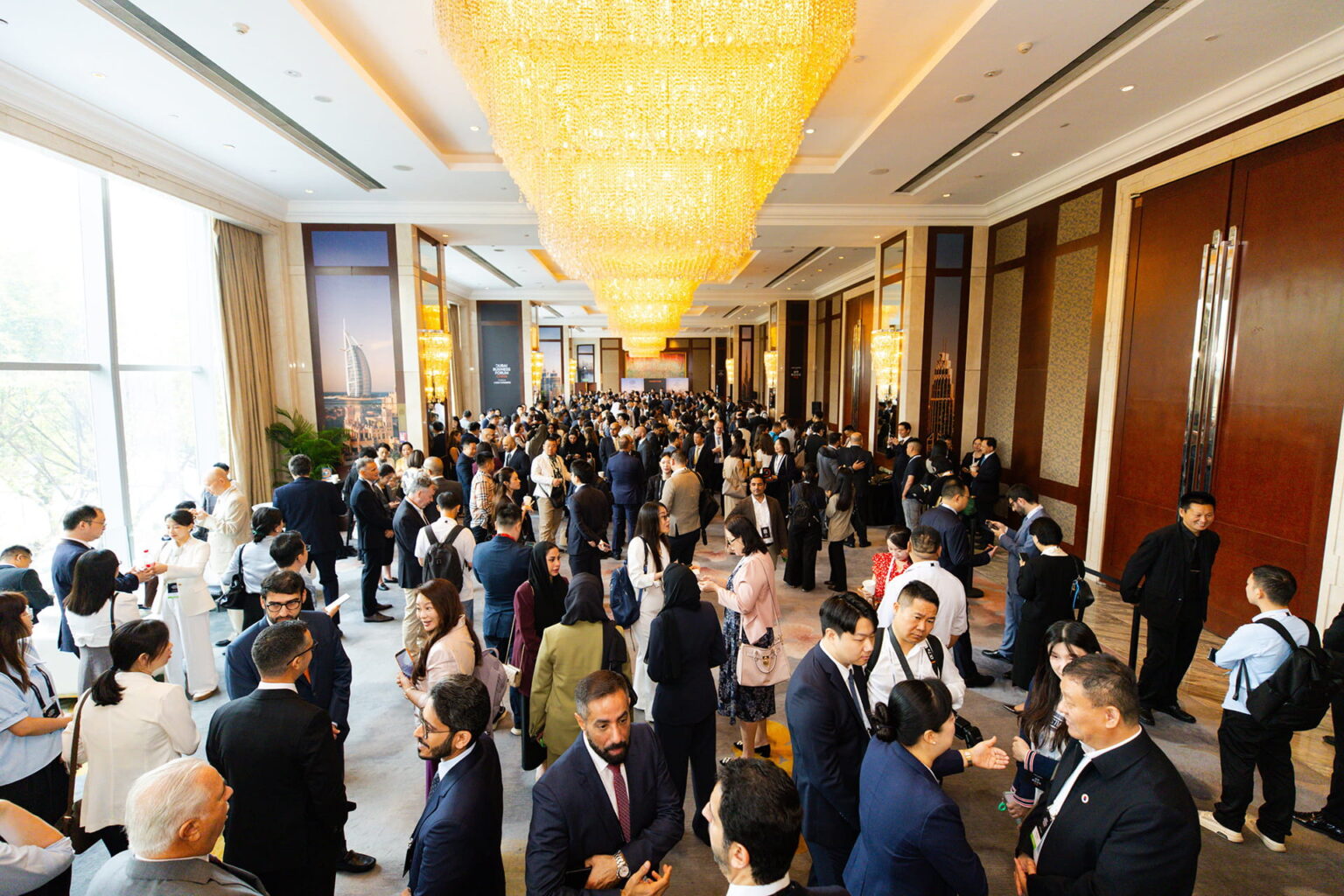
The photograph explains the event better than the press release. A hotel ballroom in Shenzhen, a chandelier the size of a small car, a banner of the Burj Al Arab on one pillar, and hundreds of people in dark suits holding coffee cups and phones. On 14 October, Dubai Chambers brought the fifth international edition of the Dubai Business Forum to the city, its second in China after Beijing in August 2024. Earlier editions were held in London, Hamburg and New York. The event was invitation-only. It drew 854 Chinese investors and business leaders and a 112-member Dubai delegation, which the chamber says is the largest overseas business delegation it has ever sent. Over 15 sessions, 22 speakers took the stage, with participants including Tencent Cloud, Huawei Cloud, BYD, China Merchants Capital, CICC and DP World. 36Kr Global was an official partner, as it was in Beijing.
A forum like this is a sales event dressed as a conference, and the product on sale is Dubai. Between sessions, organisers ran business matchmaking between Chinese companies and Dubai government representatives, investors and businesses. Ten memorandums of understanding were signed. Six connect Dubai Chambers with Chinese business organisations, including chambers of commerce in Shenzhen, Guangzhou, Beijing and Chongqing and two Greater Bay Area associations, with the stated aims of connecting businesses, easing investment and sharing information. The Dubai Chamber of Digital Economy signed with Alibaba Cloud on digital economy cooperation. Dubai CommerCity partnered with the Hong Kong-Shenzhen Innovation and Technology Park. Jewellery industry bodies from Dubai and Guangdong signed their own agreement.
A word on vocabulary. A memorandum of understanding is a statement of intent. It commits the signatories to talk, not to spend. Most MoUs signed at events like this produce a photograph and a follow-up email. The useful question is never how many were signed. It is which one comes with a site, a budget and a start date. In Shenzhen, one did.
Gargash Prime, a Dubai group, and JD Property, the infrastructure investment arm of JD.com, plan a joint venture to build a regional distribution and fulfilment hub at Dubai Industrial City. Shehab Gargash, managing director and group chief executive of Gargash Prime, told Khaleej Times the investment is expected to exceed AED 500 million, about USD 136 million, though the final cost has not been set. Construction is expected to start in 2027, and the first phase should take about 18 months. The agreement was signed on 13 October during the delegation's visit to Shenzhen, witnessed by Mohammad Ali Rashed Lootah, president and chief executive of Dubai Chambers. For a Chinese e-commerce group, a warehouse is the moment an overseas plan stops being a slide. It means inventory, staff, customs clearance and delivery promises made from inside the market.
The Editor's Note
If you are reading this and the pattern fits your business, start the conversation before the conversation starts itself. editor@unpublished.my.
The numbers behind the pitch are large. Non-oil trade between Dubai and China reached AED 363.5 billion, about USD 99 billion, in 2025, up nearly 23 percent year-on-year, and China is Dubai's largest trading partner. Chinese direct investment into Dubai rose from about AED 1.2 billion in 2024 to more than AED 3.4 billion in 2025. As of September 2026, 6,650 active Chinese companies were registered with the Dubai Chamber of Commerce, more than three times the number in 2016. The forum also serves Dubai's D33 agenda, which aims to double the emirate's economy by 2033 through industrial development, exports and diversification. Dubai's offer to Chinese companies is simple: set up here, and use us as your base for the Middle East, Africa and Europe.
The choice of Shenzhen was not accidental. Beijing gave Dubai access to policy and state capital in 2024. Shenzhen gives it the companies that actually ship products abroad. Tencent, Huawei and BYD are all headquartered in the city, and the wider Greater Bay Area is home to much of China's hardware, electronics and electric vehicle supply chain, the firms most likely to need a warehouse, a regional office and a re-export hub outside China. DP World, the Dubai ports operator, was in the room for the same reason. A Chinese manufacturer weighing where to stage inventory for the Gulf, Africa and southern Europe is exactly the customer Dubai came to meet.
AI was the other half of the conversation. Lootah spoke about pairing China's technological strength with Dubai's ability to commercialise and expand internationally, including possible direct channels for technology cooperation. Dubai Chambers runs an agentic AI transformation programme meant to speed adoption among more than 295,000 private-sector companies, with plans for 100 specialised AI assistants over two years and about 14,000 businesses in training now. A panel with Tencent Cloud and the Dubai Chamber of Digital Economy dealt with the problem every enterprise AI buyer knows: moving from pilot projects to applications that earn money. Read together, the pitch is that China builds the technology and Dubai becomes the place it is packaged and sold to the region.
Malaysia is not a bystander here. The UAE-Malaysia Comprehensive Economic Partnership Agreement was signed in January 2025 and entered into force in October 2025. Non-oil trade between the two countries was USD 5.5 billion in 2024, with a target of USD 13.5 billion by 2032, and bilateral trade rose 30.9 percent in the first half of 2025 to USD 3.3 billion. Those are healthy numbers for Malaysia. They are also roughly one-eighteenth of Dubai's trade with China. Malaysia also likes to present itself as a neutral base for Chinese companies going global. Dubai has just shown what that pitch looks like when it is run at full scale, with a chandelier. Three implications follow.
One. Do not compete with Dubai as a gateway. Compete as a supplier to the gateway. The JD Property hub at Dubai Industrial City will need goods to move through it. Malaysia's strengths, including halal-certified food and consumer products, electronics and semiconductor components, palm-based ingredients and Islamic finance, are exactly the kind of specialist inputs a Chinese-built distribution network serving Muslim-majority markets will need. The Malaysian exporter who treats a Chinese warehouse in Dubai as a customer, not a rival, finds a door that opens in two directions.
Two. Sell the expertise Chinese companies lack. Many of the 6,650 Chinese firms in Dubai are learning, at speed, how to sell into the Gulf, North Africa and wider Muslim markets. Halal certification, Shariah-compliant financing, Malay and Arabic-friendly product design and the cultural fluency to build brands for those consumers are services Malaysian firms have been practising for decades. That know-how is exportable, and Dubai is now full of potential buyers for it. Our earlier reading of Malaysian halal exports to the Gulf found that much of the recent growth came from diverted supply rather than new demand. Advisory and compliance services are a way to earn from the corridor without having to win a price war on volume.
Three. Measure trade missions by what gets built. Dubai sent 112 people and its chamber chief, ran matchmaking for the whole day and came home with a warehouse. Malaysian trade missions to China are frequent and well intentioned, and they too tend to be reported in MoUs signed and ringgit of potential deals. The better scoreboard is the one Dubai implicitly used: how many agreements have a site, a budget and a construction date. A mission that returns with one real joint venture has done more than one that returns with twenty signed letters.
The headline counts ten deals. The business underneath counts one warehouse and a very clear sales pitch. Dubai is not waiting for Chinese companies to discover it. It is flying to Shenzhen to recruit them. Malaysia can learn from that without trying to copy it.