The Chinese milk tea category has been one of the most competitive consumer goods sectors in the world for the past five years. Nayuki, Heytea, Chagee, Mixue, and roughly a dozen other national chains have been fighting for market share across a category that produces impressive top-line growth and mostly unimpressive unit economics. The competitive dynamic has forced every major operator to search continuously for adjacent categories that can extend the store network's revenue without cannibalising the core beverage business. Ice cream. Bakery. Ready-to-drink beverages. Coffee. Merchandise. Each new adjacency is tested inside the store network first, then, if the economics work, spun into a distribution channel that can reach customers the stores do not.
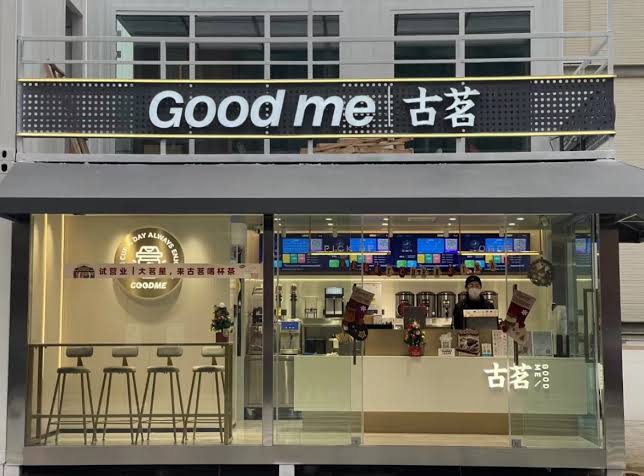
GoodMe just announced its version of that move, and it is more strategically interesting than the trade press coverage has been treating it. The company will bring its HPP juice products (which have been sold only inside its own stores since December 2025) into external retail channels, including Laopo Daren snack discount stores, Yonghui Superstores supermarkets, and Shizu convenience stores. The initial launch cities are Guangzhou, Shenzhen, Hong Kong, Wenling, and Hangzhou. Both of the products moving into retail are 260-gram bottles. HPP apple juice will retail at RMB 9.9, about USD 1.5. HPP seven-ingredient fruit and vegetable juice will retail at RMB 11.9, about USD 1.7. Both prices are RMB 2 higher than the same products sold in-store, which is normal channel pricing behaviour. Both prices are also meaningfully below the RMB 14+ that VCleanse and Per Se command in the same 260-gram format, and below the RMB 11-13 range that Nongfu Spring and Beibingyang occupy on a converted-to-260ml basis.
The pricing move is the surface story. The strategic story is the operational asset underneath the pricing move. HPP, short for high-pressure processing, is a non-thermal preservation method used in premium juice production. It preserves the taste closer to freshly squeezed juice without heat treatment. The trade-off is that HPP equipment requires significant upfront capital investment, and the finished product must remain refrigerated throughout the entire supply chain from factory to consumer. Most HPP juice brands in China rely on third-party contract manufacturers and third-party cold chain logistics because building both is capital-intensive and operationally complex. GoodMe has done what almost no other tea chain operator has done. It has built its own HPP production line, operates its own cold chain across its 13,554 stores, and now has the internal capacity to feed both its store operations and its external retail distribution using the same infrastructure.
That vertical integration is the piece the F&B trade press should be pricing more carefully than it has been. Heytea and Nayuki's ready-to-drink products are shelf-stable, made through contract manufacturers, and priced to compete in the mainstream retail juice category. GoodMe's ready-to-drink products are HPP, made on self-built production lines, distributed through its own cold chain, and priced below the mainstream retail juice category despite carrying meaningfully higher production costs. The pricing is only sustainable because the cold chain is already amortised across the tea store network. External HPP juice players cannot match the pricing because they would have to absorb the full cold chain cost against retail juice volume alone. GoodMe can amortise the cold chain against 13,554 tea stores plus retail juice sales, which changes the unit economics of the retail juice business at a level that competitors structurally cannot match.
The Editor's Note
If you are reading this and the pattern fits your business, start the conversation before the conversation starts itself. editor@unpublished.my.
The geographic sequencing also reveals the strategic discipline. GoodMe is launching first in Zhejiang and Guangdong. Both are provinces where GoodMe's store density is highest and its cold chain is most developed. Marginal cost per bottle in those two provinces is materially lower than it would be in provinces where the cold chain has not yet been fully built out. The company is deliberately sequencing its retail expansion to match the geography of its infrastructure investment. That kind of disciplined sequencing is the difference between a food and beverage operator that scales profitably and one that scales into a working capital crisis.
For the Malaysian and broader Southeast Asian F&B chain operator, four implications run from this story.
One. The infrastructure asset underneath your store network is likely worth more than the store-based revenue you are currently measuring it against. GoodMe's cold chain, built to serve its milk tea stores, is now supporting a materially different second business at meaningfully higher margins. Malaysian F&B chain operators with cold chain assets, kitchen production lines, packaging capacity, or point-of-sale networks should be evaluating what second revenue streams the existing infrastructure could support. The evaluation is straightforward. What products would the infrastructure enable us to make that competitors would have to build the infrastructure to make? Every operator has a candidate. Very few have priced it.
Two. The retail pricing move should be studied for its structural insight, not its specific price point. Malaysian F&B chains cannot directly replicate GoodMe's RMB 9.9 pricing because the underlying cost structure is different. But the structural insight (that a vertically integrated operator can consistently price below single-purpose competitors by amortising infrastructure across multiple revenue streams) is portable. Malaysian chains considering entry into ready-to-drink beverages, packaged foods, or grocery private-label categories should be reading GoodMe's playbook as a template for how the pricing advantage gets constructed.
Three. The specific choice of HPP as the entry category is a deliberate positioning decision the Malaysian operator should be studying. GoodMe chose HPP because it is a niche category where GoodMe's cold chain becomes a genuine competitive advantage rather than a marginal cost saving. The Malaysian operator considering the equivalent expansion should be asking which specific category the operator's existing infrastructure produces the largest structural cost advantage in. That category is the correct entry point. The category with the largest addressable market is usually not the correct entry point, because the largest addressable market is where the competitors have already built comparable infrastructure.
Four. The 13,554-store base is the specific scale at which the retail expansion becomes credible for a chain operator. Malaysian F&B chains generally operate at meaningfully smaller store counts (Old Town White Coffee at approximately 200 outlets, Secret Recipe at approximately 300 outlets, Marrybrown at approximately 500 outlets globally). The specific tactic GoodMe is using does not directly transfer at Malaysian chain scale. However, the underlying operational logic does transfer if Malaysian chains coordinate. Three to five mid-sized Malaysian F&B chains, sharing a jointly operated cold chain and a jointly operated retail packaging line, could achieve the effective scale that GoodMe achieves individually. That kind of chain coordination has not happened in Malaysia yet. The specific reason to attempt it now is that the retail category economics currently favour the operators who have the infrastructure, and Malaysian chains individually do not.
The headline is a Chinese tea chain launching bottled juice in supermarkets. The story is that vertical integration across cold chain, production, and distribution produces pricing advantages that single-purpose competitors cannot structurally match. The Malaysian F&B chain operator who reads the retail expansion as a retail expansion is reading the wrong version. The right version asks which of the operator's existing infrastructure assets could support a second revenue stream priced below what dedicated competitors could offer.