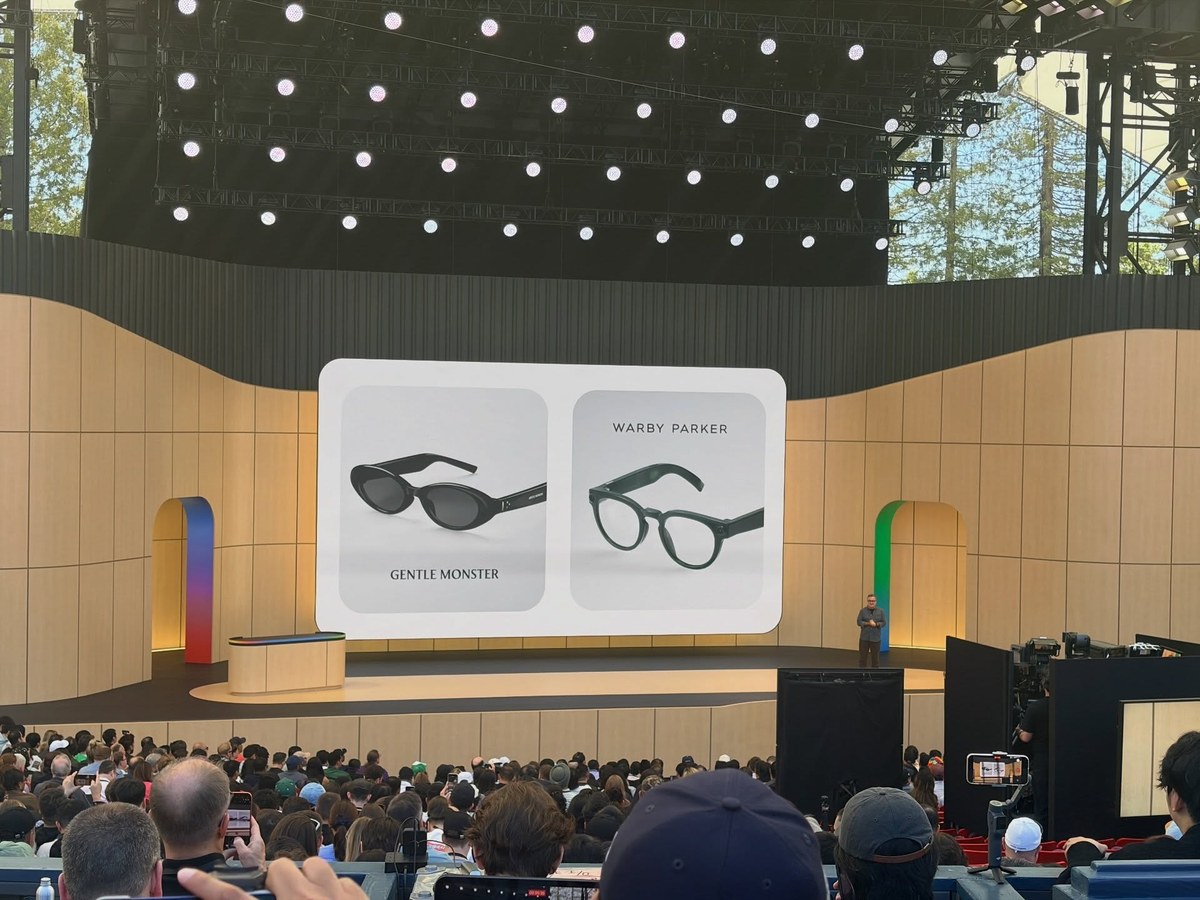
At Google I/O 2026, on a stage in Mountain View, Google and Samsung announced the first consumer Android XR smart glasses. The hardware partners on the lens side are not Google. They are not Samsung. They are not Qualcomm, who is supplying the chips. The two names on the slide were Gentle Monster, a Korean fashion eyewear brand, and Warby Parker, an American direct-to-consumer optical brand. The audio-only glasses launch this fall. Gucci, through parent company Kering, is in for 2027. Display-equipped versions are on a separate track.
The Google blog post called it intelligent eyewear. The headlines called it AI glasses. Neither label captures what just happened.
What just happened is that the dominant platform in consumer technology publicly conceded that it cannot win this category alone. Google built the Android XR operating system. Google built Gemini. Google built the integration with Search, Maps, Translate, Calendar, and Photos. The thing Google could not build, and explicitly outsourced, is the reason a consumer would wear the product in public. That part went to fashion houses.
Read that paragraph again if you operate in any wearable consumer category in Malaysia or the broader region.
The features being demonstrated are exactly what every smart glasses pitch has promised for a decade. Real-time translation that matches the speaker's tone and pitch rather than synthesising a flat voice. Turn-by-turn navigation that does not require pulling out the phone. Summarised notifications. Visual translation of menus and signage in the wearer's field of view. Hands-free photo capture. A Gemini agent that can queue actions on the phone in your pocket, like ordering a coffee as you walk past the café, leaving only a confirmation tap.
These are not new capabilities. Google Glass demonstrated several of them in 2013 and the product failed completely. Meta's Ray-Ban collaboration has sold more than seven million units in 2025 alone and now holds roughly 82% of global smart glasses shipments. The capability question is settled. The acceptance question is not.
What changed between Google Glass in 2013 and the Gentle Monster reveal in 2026 is the answer to the acceptance question. The answer is that you do not solve consumer wearable acceptance with a technology company brand on the frame. You solve it by putting a fashion brand on the frame that the customer would have already considered buying without any technology inside it. The technology becomes invisible. The fashion brand becomes the buying decision.
The Gentle Monster choice is the more interesting half of the announcement. Warby Parker is an American direct-to-consumer optical brand with a known operational competence and a clean aesthetic. The collaboration there is logical. Gentle Monster, founded in Seoul in 2011, is a different animal. The brand built its position through experiential retail, surrealist store design, deliberately provocative campaigns, and creative collaborations across luxury and street culture. Their stores are art installations. Their pricing sits well above mass-market optical. Their customer is the design-forward Asian consumer who would otherwise be considering Acne Studios, Loewe, or Bottega Veneta for sunglasses. Google's partner for the more fashion-forward of the two announced models is a Korean luxury brand. Not an American one. Not a European one. Korean.
This is the part the Western tech press has not fully processed. The aesthetic gravity of consumer fashion has shifted East. K-pop, K-beauty, K-fashion. The Korean creative export has been compounding for a decade. Gentle Monster sits at the centre of that. The fact that Google picked them, ahead of European luxury houses for the first wave, is the platform recognising where the cultural permission lives now.
Now bring this back to Malaysian operators. There are three lessons sitting on the table, none of them being said out loud in the local trade press.
The Editor's Note
If you are reading this and the pattern fits your business, start the conversation before the conversation starts itself. editor@unpublished.my.
First lesson. The category that was consumer electronics is becoming consumer fashion with AI inside. This is not a marketing reframe. It is a structural change in who captures the value. The hardware partner gets a margin. The platform gets the recurring revenue from the AI services. The fashion brand gets the cultural permission to charge premium and the customer loyalty that comes with it. The Malaysian operator who is selling sunglasses, prescription frames, watches, or any wearable item without an aesthetic position needs to understand that the next round of products in their category will arrive with AI inside and a fashion brand on the outside. The race to compete on technology is already lost. The only race left is to compete on aesthetic identity strong enough that customers want to wear the product before they know what is inside it.
Second lesson. The Asian luxury moment is not coming. It is here. Gentle Monster sitting at the Google I/O announcement, on the same slide as Warby Parker, is the public confirmation. The Asian operator who can build genuine aesthetic conviction at the product level is now being chosen by the largest platforms in the world over Western luxury houses. That door is open. The Malaysian operator who has spent twenty years borrowing European positioning is competing for a category that the platforms have already decided to source from Asia. The bias is no longer in favour of European-sounding brands. The bias is in favour of brands that have actual cultural permission with the customer the platform is trying to reach.
Third lesson. The displacement is starting at the smartphone. Samsung explicitly positioned these glasses as companion devices that allow tasks to be done without taking out the phone. That is the framing. Companion. What every smart glasses pitch over the next five years will quietly converge toward is replacement. Replacement of the phone-based interaction model. Replacement of the camera that always sits in your pocket. Replacement of the screen as the primary interface. The Malaysian operator in any business that depends on the smartphone screen as the customer interface should be modelling what their business looks like when that screen is no longer the dominant attention surface.
Retailers should read this and ask whether the customer browsing in their store five years from now will be looking at the merchandise or at a Gemini agent pricing it, comparing it, and queueing the order on a different platform without the customer needing to make eye contact with a salesperson. F&B operators should read this and ask whether the menu they print today survives the moment when the customer can look at the table next door, identify the dish, and order it through their glasses. Marketers should read this and ask whether the visual advertising that depends on the customer holding up a phone retains any value when the customer's primary visual layer is augmented by an AI agent that filters reality before the marketer reaches it.
These are not science fiction questions. The hardware launches this fall. The category is not coming. It has been announced. The only variable is the speed at which Malaysian operators move from observation to action.
What is launching first is audio-only. There is no display in the lens. The first generation will work through onboard speakers and a side-mounted camera that feeds the Gemini agent. The visible footprint of the technology is therefore small. The glasses will look like normal Gentle Monster or Warby Parker frames, with the technology hidden in the temples and bridge. This is the deliberate design choice that allows the fashion brand to be on the front of the product instead of the tech brand. It is also the design choice that makes the next phase of adoption socially viable in a way that earlier smart glasses never were.
Display-equipped models are coming separately. Google has confirmed the second track but has not given a date. When the display layer arrives, the interaction model becomes substantially more powerful. Until then, the audio-only product is the proving ground for whether consumers will actually keep these on their faces through a normal day. If the answer is yes, the entire wearable consumer technology category gets re-mapped against the smart glasses platform within twenty-four months.
The Malaysian operator should be doing two things right now. One. Documenting which parts of the business currently depend on the smartphone as the customer's primary interaction surface, and modelling what the same business looks like when the smartphone is supplemented or replaced by an ambient AI layer. Two. Auditing the operator's own brand for aesthetic conviction. The Western luxury frame that has dominated Malaysian premium positioning for thirty years has just been outflanked by a Korean brand picked by Google. The window in which Malaysian, Indonesian, and Southeast Asian operators can build their own aesthetic position at premium price points is opening because the largest platforms have publicly endorsed Asian luxury as their distribution channel of choice.
Would you replace your phone with AI glasses, asks the typical reaction post on Threads. The wrong question. The right question for any operator in this region is whether your business survives the moment when the answer to that question becomes yes for ten percent of your customers. If you do not have a clear answer to that question by the end of this year, your business has already started competing in a category it has not yet recognised.