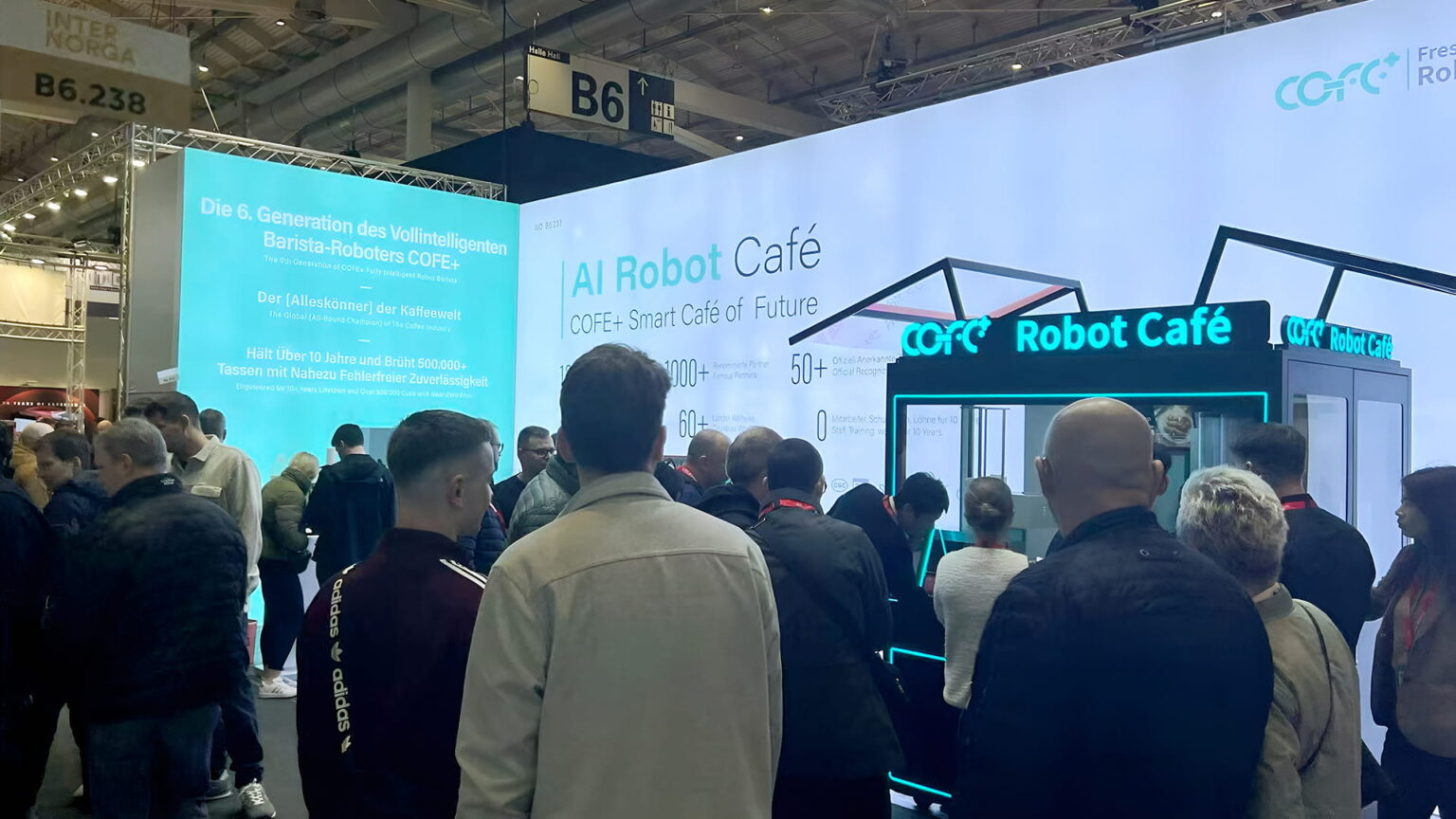
The specific commercial reality underneath the global coffee shop category is that rent, labour, and renovation amortization account for 60 to 70 percent of total operating costs at mature chains including Starbucks and Luckin Coffee, and those cost line items continue to rise structurally year on year. Baristas who can consistently produce latte art at the quality level required for premium coffee positioning are expensive to train and have persistently high turnover across every major market. That specific cost structure is the commercial problem that Hi-Dolphin Robot Technology set out to solve in 2018. Founded in Beijing, the company spent eight years and eight product iterations working on a specific commercial hypothesis: that if the coffee production process could be automated to the point where it reliably delivered coffee quality and latte art comparable to a human barista, the resulting unit economics would be transformational for the entire category. Hi-Dolphin's answer is Cofe+, an eighth-generation coffee robot standing nearly two metres tall and about 1.5 metres wide that produces a cup of coffee with customised latte art and serves it through a glass window in less than one minute. The specific commercial claim the company makes is that a Cofe+ installation delivers comparable coffee quality at about 70 percent of the capital and operating cost of a conventional cafe.
The specific deployment scale Hi-Dolphin has achieved is worth reading precisely because it validates the commercial hypothesis. The company reported in August that its Cofe+ robots have deployed in 70 countries and regions across more than 200 international cities, with nearly 4,000 locations in total and about six million beverages produced to date. The specific reference deployments include Harvard University, Massachusetts General Hospital, the National University of Singapore, Denver International Airport, Kuala Lumpur International Airport, and Google's headquarters. The robots have also appeared at the World Economic Forum Annual Meeting in Davos and at China's annual Two Sessions political meetings. Only 40 of the 4,000 locations are company-operated stores (used primarily for product testing and customer feedback collection). The remaining locations are operated by business partners under one of five distinct commercial models that Hi-Dolphin has developed to accommodate different customer types. That specific operating structure (small company-owned reference footprint, large partner-operated deployment base, five distinct commercial models) is the specific commercial infrastructure that lets Hi-Dolphin scale globally without needing to directly operate thousands of locations.
The five commercial models are worth articulating precisely because they show how Hi-Dolphin has structured its go-to-market for different customer types. Under the agency model, customers operate under the Hi-Dolphin brand, with machines deployed mainly at airports, tourist attractions, and similar high-traffic locations. Under the purchase model, customers buy the equipment outright and install it on properties they own. The customization model targets major brands and large companies, with customers using their own branding and customizing the robot's exterior to match corporate identity. The leasing model targets financial institutions, government agencies, public institutions, and other organisations that are not permitted to engage in commercial activities outside their primary functions. Under the joint-operation model, which is designed for high-profile locations such as landmark buildings, Hi-Dolphin funds the equipment itself and shares revenue with the host location. The specific commercial consequence of running five models simultaneously is that Hi-Dolphin can engage with essentially every potential customer category on terms that fit that customer's specific operational, legal, and financial constraints.
The technical sophistication underneath the product is worth reading precisely because it explains why Hi-Dolphin's product differentiates from generic coffee automation. Co-founder Han Feizi told the Chinese trade press that whether latte art succeeds is not fundamentally a question of how precisely the robotic arm's movements are controlled. It is a fluid dynamics problem. The Cofe+ robot uses fluid dynamics modeling to calculate how milk foam flows, spreads, and builds up on espresso in real time, translating latte art designs into measurable physical variables. When a customer uploads an image or text, Hi-Dolphin's algorithm works backward in real time to calculate how to control the milk flow, and the robotic arm then reproduces the design on the coffee's surface. The seventh-generation product further refines grinding and extraction settings to improve flavor while maintaining consistency across cups. At the Hongqiao Robot Coffee Competition in May, professional judges rated the seventh-generation product's coffee at least as highly as human coffee masters on taste. The specific commercial implication is that Hi-Dolphin has crossed the quality threshold where the output is no longer distinguishable from skilled human barista output on blind taste tests.
The Editor's Note
If you are reading this and the pattern fits your business, start the conversation before the conversation starts itself. editor@unpublished.my.
The international adaptation requirements the company has worked through over the past five years are the piece Malaysian operators should be studying with practical attention. Hi-Dolphin began expanding overseas in 2021 with a prospective order from Expo 2020 Dubai for 50 coffee robots. The international expansion required solving specifically different operational problems in each market. In humid countries like Brazil, the company had to engineer against moisture exposure to circuits and materials. In the dry static-prone Middle East, it had to protect precision sensors from electrostatic disruption. In Japan, where stores can be small with narrow doors and passageways, the wheeled machine had to be designed to move freely in and out, and the company had to account for water hardness and mineral content effects on coffee taste. In mature markets like Europe, the US, Japan, and South Korea, extraction heads, milk tubes, water tanks, and cup holders had to meet US FDA requirements, the EU's EC 1935/2004 regulation, and Japan's Food Sanitation Act. The specific operational discipline Hi-Dolphin articulates is that software and content localisation (interface languages, menu recipes, payment methods, brand colors, latte art designs) is relatively easy to implement, while interface and compliance localisation (voltage, plugs, local certifications, plumbing, water quality, consumables) must be designed into the product rather than retrofitted. The underlying motion control, fluid dynamics algorithms, and mechanical architecture remain globally standardised.
The specific KLIA deployment is the piece the Malaysian hospitality operator should read with particular attention. Hi-Dolphin has publicly listed Kuala Lumpur International Airport as a reference deployment. The specific implication is that Malaysia Airports Holdings Berhad has already engaged with Hi-Dolphin on at least one deployment under one of the five commercial models, which means the operational and compliance groundwork for the Malaysian market has been established. Malaysian hospitality operators evaluating robot cafe deployment should be able to establish commercial conversations with Hi-Dolphin at materially lower friction than operators in markets where no reference deployment exists.
For the Malaysian and broader Southeast Asian operator, four implications run from this story.
One. The Malaysian hospitality operator (Genting Malaysia, YTL Hotels, Sunway Hotels, Berjaya Hotels, Shangri-La Hotels Malaysia, and the various independent and regional hotel chains) should be reading Hi-Dolphin's five commercial models as a specific template for structuring robot deployment partnerships. The specific commercial move is to identify which of the five models (agency, purchase, customization, leasing, joint-operation) best fits the specific hotel operator's capital allocation preferences and operational control requirements, then initiate the commercial conversation with Hi-Dolphin's regional team on the chosen model structure. The KLIA reference deployment materially lowers the friction for Malaysian hospitality operators engaging with Hi-Dolphin.
Two. The Malaysian hospital operator (KPJ Healthcare, IHH Healthcare, Sunway Medical, Columbia Asia, Island Hospital Penang, Prince Court Medical Centre) should be reading the Massachusetts General Hospital reference deployment as validation that robot cafes operate successfully within healthcare facility operating environments. Hospitals have specific operational requirements (24-hour operation, infection control protocols, patient and visitor flow dynamics) that most consumer retail robot deployments do not have to accommodate. Hi-Dolphin's proven hospital deployment experience makes the operator a specifically suitable partner for Malaysian hospital food service modernisation.
Three. The Malaysian educational institution operator (University of Malaya, Universiti Teknologi Malaysia, International Islamic University Malaysia, Taylor's University, Sunway University, Monash University Malaysia) should be reading the Harvard University and National University of Singapore reference deployments as validation that robot cafes fit campus food service operating environments. The specific operational pattern is that university campuses have peak-and-trough demand cycles (busy during class breaks, quiet during lectures) that match the robot operating model well, because the robot does not require continuous labour cost even during low-demand periods. Malaysian universities evaluating campus food service modernisation should be considering robot cafe deployment as a specific option.
Four. The Malaysian commercial property operator (Pavilion REIT, KLCC Property, Sunway REIT, IOI Properties, UEM Sunrise) should be reading Hi-Dolphin's commercial infrastructure as a specific opportunity to add robot cafe tenants to commercial office buildings and premium retail properties. The specific operational advantage of the robot cafe tenant is that it occupies minimal floor space (a few square metres), operates 24 hours without labour cost increases, and produces consistent per-square-foot revenue that compares favourably with traditional food service tenants. Property operators that establish early commercial partnerships with Hi-Dolphin can offer their commercial tenants and office workers premium coffee access as a building amenity that differentiates the property from competitors.
The headline is a Chinese coffee robot company at 4,000 locations across 70 countries. The story is the specific five-model commercial infrastructure, the proven cross-border operational adaptation discipline, and the already-established KLIA reference deployment that collectively make Hi-Dolphin a specifically accessible commercial partner for Malaysian hospitality, healthcare, education, and commercial property operators. The Malaysian operator who reads the Cofe+ scale as a Chinese robotics story is reading the wrong version. The right version asks which specific commercial conversation with Hi-Dolphin should be initiated this quarter under which specific commercial model structure.