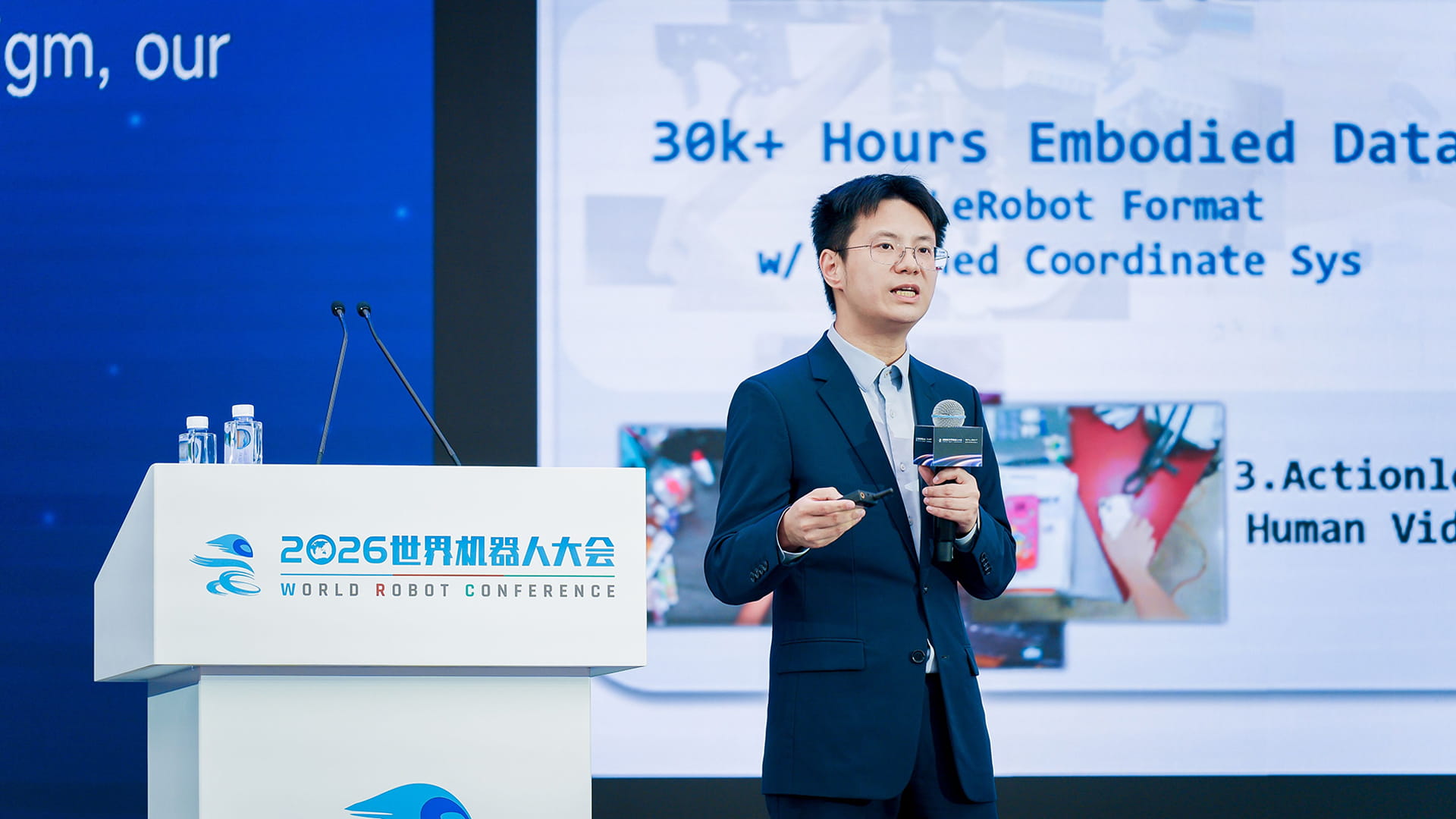
The Chinese humanoid robotics category has spent the past five years being characterised primarily as a hardware competition. Unitree, AgiBot, LimX Dynamics, Fourier Intelligence, and roughly a dozen other Chinese operators have been racing to establish position across the underlying hardware layer: actuators, sensors, structural design, thermal management, and motion control. That framing was directionally correct for the period 2021 through 2025, when the hardware layer was the specific bottleneck determining which operators could produce humanoid robots capable of executing meaningful commercial tasks. The framing is now becoming less accurate. The category has quietly shifted its competitive frontier from hardware to intelligence, and the Chinese trade press coverage of the 2026 World Robot Conference in Beijing this month provided the specific evidence of that shift.
Galbot founder Wang He, speaking at the conference, was direct about the reallocation. Wang argued that humanoid robotics competition is moving from motors, joints, and mechanical structures to models, data, and world simulation frameworks. His specific framing was that the hardware layer is becoming a commoditised input, while the intelligence layer is becoming the durable competitive advantage. That framing has significant implications for how capital should be allocated across the category, and for how downstream operators should be evaluating their exposure to the humanoid robotics value chain over the next thirty-six months.
The specific bottleneck Wang identified is training data. Large language models needed roughly a decade to accumulate the internet-scale text data that enabled the specific capability breakthroughs of 2022 to 2025. Embodied intelligence, which is the trade press term for AI systems that operate physical robots in real-world environments, requires equivalent scale and quality of training data. That data does not exist yet. The internet does not contain the specific type of data (multimodal sensor data, tactile feedback, physical interaction data, environmental context data) that embodied intelligence needs. Building that data corpus requires deliberate investment in data collection infrastructure, not passive scraping of existing datasets. Whichever operator builds the data collection infrastructure fastest establishes the specific competitive advantage that determines the winners of the next phase of humanoid robotics competition.
The competitive moat that Wang described has three specific components. First, real-world data collection systems: hardware and software infrastructure that enables the systematic collection of interaction data from robots operating in commercial environments. Second, simulation environments: virtual worlds that allow robots to accumulate training data faster than physical-world operation would allow. Third, evaluation frameworks: systematic testing protocols that measure whether specific robot behaviours meet the required thresholds for commercial deployment. Galbot, AgiBot, and several other Chinese operators are building this coordinated three-part infrastructure. Operators that focus only on hardware without building the data infrastructure will find themselves at a structural disadvantage as the category matures.
The Editor's Note
If you are reading this and the pattern fits your business, start the conversation before the conversation starts itself. editor@unpublished.my.
The specific hardware commoditisation is worth reading precisely because it changes the economics of the humanoid robotics category. Motor and actuator costs have declined roughly 40 percent per year over the past three years, according to industry benchmarks. Structural component costs have declined similarly. Battery costs continue their long-established decline curve. The specific consequence is that the hardware bill of materials for a humanoid robot has fallen from roughly USD 150,000 in 2022 to under USD 40,000 in mid-2026 for equivalent-specification units. That cost decline is welcome for the category overall, but it is also the specific signal that hardware differentiation is becoming less commercially valuable. If every serious operator can produce hardware at similar cost and similar capability, the competitive edge must come from a different layer of the stack.
The parallel with the automotive category is worth articulating explicitly. The automotive industry underwent an equivalent transition roughly ten to fifteen years ago, when the mechanical drivetrain became increasingly commoditised and the software-defined vehicle became the durable competitive advantage. Tesla established its market position by treating the vehicle primarily as a software platform. The traditional automakers that continued to compete on mechanical drivetrain differentiation gradually lost strategic position. That specific transition took about a decade for the automotive category. Humanoid robotics appears to be running an equivalent transition compressed into a shorter timeframe, likely three to five years. Operators that make the transition early will capture the strategic position. Operators that do not will be left with commoditised hardware businesses competing on price rather than on capability.
The Chinese domestic context deserves mention because it explains the specific competitive dynamic driving the reallocation. China's humanoid robotics category has attracted more than USD 8 billion in cumulative venture funding over the past two years. That capital has flowed disproportionately into hardware-focused operators, on the assumption that the hardware layer was the specific bottleneck. As the hardware layer commoditises, that capital allocation will produce disappointing returns unless the operators pivot toward the intelligence layer. Wang's framing at the World Robot Conference is essentially a public signal to the venture capital ecosystem that the allocation needs to shift. Whether the shift happens fast enough to preserve the value in existing hardware-focused portfolios is the specific question that will determine several billion dollars of capital returns over the next thirty-six months.
For the Malaysian and broader Southeast Asian operator, four implications run from this story.
One. The Malaysian technology investor with exposure to humanoid robotics through venture allocations should be evaluating whether the exposure is captured primarily at the hardware layer or at the intelligence layer. Exposure to hardware-focused operators will produce declining returns as the category matures. Exposure to intelligence-layer operators (data collection infrastructure, world model providers, simulation platform operators) will produce compounding returns as the category matures. The specific reallocation decision needs to be made in the next twelve months, before the intelligence-layer valuations reprice to reflect the strategic position.
Two. The Malaysian industrial operator considering humanoid robotics deployment for its own operations should be evaluating operators based on their data collection infrastructure, not primarily on hardware specifications. An operator with strong data collection infrastructure will produce steady capability improvements over the deployment lifetime. An operator without data collection infrastructure will produce a fixed-capability system that does not improve over time. The specific choice is between deploying a system that improves versus a system that does not, and the decision materially affects the long-term economics of the deployment.
Three. The Malaysian software services operator has a specific opportunity to participate in the humanoid robotics category as a data annotation and evaluation services provider. The category needs meaningful investment in human-in-the-loop data annotation, evaluation testing, and quality assurance. Malaysian software services operators (particularly those already serving the AI training data category for language models) have specific capabilities that transfer directly to the embodied intelligence data category. The specific commercial opportunity is entering the category as a services provider now, before the reference services relationships are established with Indian, Filipino, or Vietnamese competitors.
Four. The Malaysian academic research ecosystem should be evaluating whether its humanoid robotics research is aligned with the shifted competitive frontier. Malaysian university research programmes in robotics currently emphasise hardware topics disproportionately relative to the strategic value shift. Reallocating research investment toward embodied intelligence, world models, and data infrastructure would position Malaysian academic outputs to be commercially valuable to the operators building the intelligence-layer businesses. The current research allocation will produce academic outputs that are increasingly disconnected from where the commercial value is being created.
The headline is that humanoid robotics competition is shifting from hardware to intelligence. The story is the specific reallocation decisions that Malaysian technology investors, industrial operators, software services providers, and academic researchers need to be making in the next twelve to eighteen months to be positioned on the correct side of that shift. The Malaysian operator who reads the shift as a Chinese robotics story is reading the wrong version. The right version asks which specific layer of the humanoid robotics value chain the operator should be building exposure to now, before the strategic positioning consolidates.