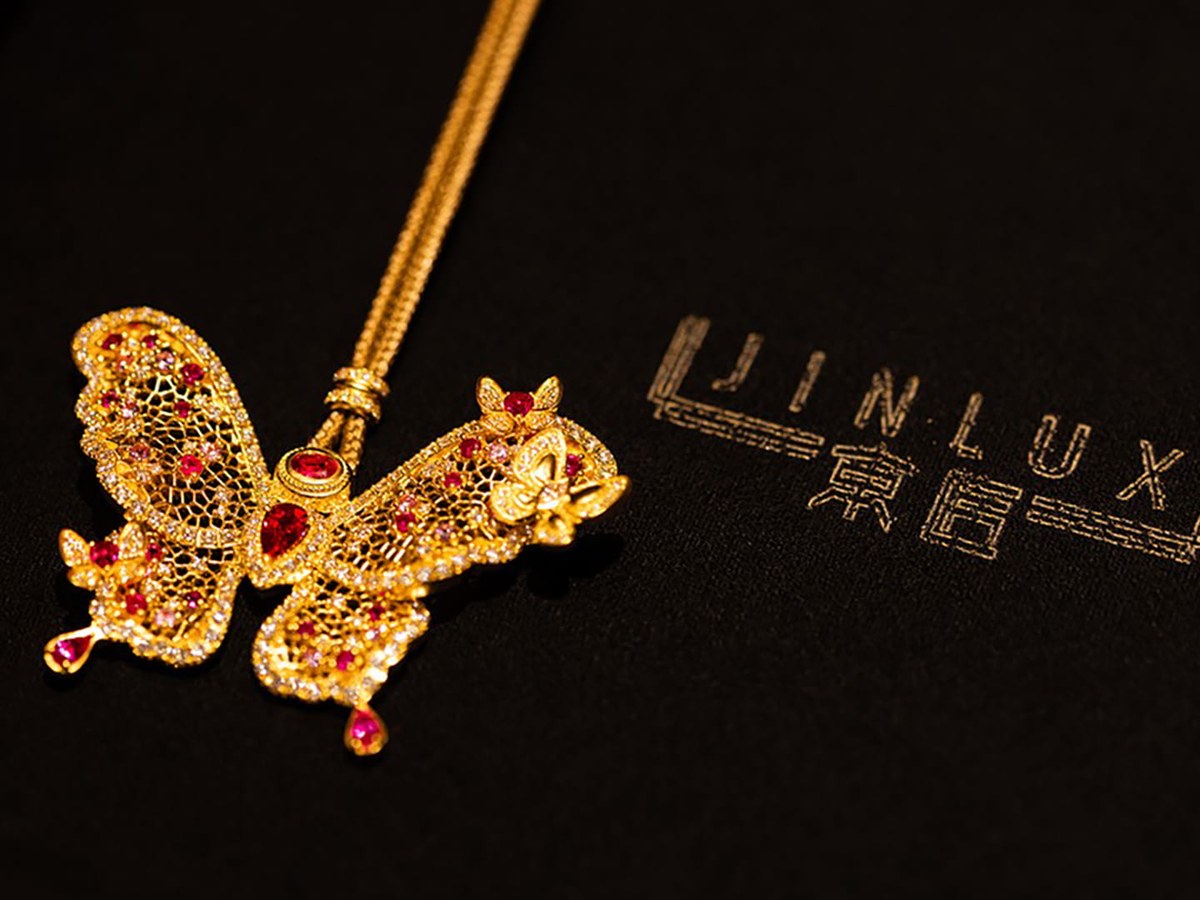
In April, Jinlux moved into a temporary slot in China World Mall in Beijing's central business district. The slot had been occupied by Jaeger-LeCoultre. A Richemont-owned Swiss watchmaker. Old money. European pedigree. The kind of brand Malaysian operators still cite when they want to sound serious about luxury.
Less than a week after opening, Jinlux was the busiest store in the south zone of the mall. Long queues. Heavy foot traffic. Cross-regional customers flying in from Shandong to buy in person. Hangzhou Tower flagship reported monthly sales per square meter above RMB 1 million. That number puts Jinlux's store productivity ahead of some international luxury brands operating in the same building.
This is the part the press release version of the story buries.
Jinlux is not winning by being cheaper than Cartier. Jinlux is winning by charging Cartier prices while the European brand is still trying to figure out why nobody under 35 is walking in. The brand is positioned in the same malls, on the same floors, against the same competitive set. And it is taking share through aesthetics, cultural symbol, and craft specificity. Not through discount.
Read that paragraph again if you run a Malaysian business that still believes the route to growth in this region is matching European premium positioning at 30% lower price.
The Jinlux operating model has five components worth studying. Each one is a decision Malaysian luxury and near-luxury operators are not making.
One. They never sold by gold weight. Traditional Chinese gold jewelry retailers price by raw material. The customer walks in, the salesperson weighs the piece, the price is RMB per gram plus a workmanship fee. Jinlux refused this from day one. Their pricing logic is design, craftsmanship, brand. Same as Cartier. Same as Bulgari. The number on the tag has nothing to do with the spot price of gold.
Two. They built a category nobody else owns. Gold-and-ruby. Not pure gold. Not Western pavé diamond. A pairing distinct enough that one Jinlux supplier reportedly saw ruby prices climb 50% on the upstream side as the brand's aesthetic gained traction. That is what owning a category looks like. The market reorganises around you.
Three. They sit alongside international luxury houses, not below them. Hangzhou Tower Block B. Wuhan's Wushang Mall. Beijing's China World Mall. These are the most selective commercial landlords in China. They reject brands routinely. Jinlux is in all four. The brand subjects itself to the same screening as the European houses and meets the same standards.
Four. They borrowed Western craft to express Eastern philosophy. French lacework. Italian fabric-texture techniques. Swiss pivot mechanisms. Applied to Chinese aesthetic foundations. The founders understood that aesthetic sovereignty and craft sovereignty are different problems, and that you can buy the second to amplify the first.
Five. They are operating with a clear capital intent. The co-founder has confirmed external investor conversations and a planned capital raise at the appropriate moment. Thirty to fifty stores planned over the next three years. The capital is not for survival. It is for compression of the expansion window before competitors copy the playbook.
Now look at how this maps to Malaysia.
The Editor's Note
If you are reading this and the pattern fits your business, start the conversation before the conversation starts itself. editor@unpublished.my.
Malaysian luxury and near-luxury operators have spent two decades importing European positioning. Cologne and watch retailers that frame themselves as European. Fine jewelers that compete on diamond weight and certification rather than design language. Fashion brands that hire European creative directors to legitimise their work. The product is competent. The positioning is borrowed. The pricing power is therefore borrowed too, and limited to whatever the European brand allows.
The Jinlux template is the opposite. Build the aesthetic from your own cultural foundation. Apply imported craft to amplify it. Charge for the design, not the material. Place yourself adjacent to the European houses and let the customer decide.
The Malaysian operators who could do this exist. The cultural material is there. Songket weaving, Peranakan motifs, Mughal-influenced pattern systems, batik with provenance, Malay silversmithing traditions that predate any European house operating in this region. The craft barriers can be bought from Europe in the same way Jinlux bought them. The customer base is there. Wealthy Malaysian, Indonesian, and Singaporean buyers who are bored of being sold a French logo at a Malaysian markup.
What is missing is the conviction to charge premium for it.
Most Malaysian operators in this space, when they are honest, will tell you that they do not believe the Malaysian customer will pay European prices for Malaysian work. So they discount their work to compete with the discounters, and the customer learns that Malaysian luxury is the cheaper version of European luxury, and the price ceiling is set for a generation.
Jinlux is proof that conviction is the variable. The Chinese consumer in 2014 also did not believe Chinese luxury was worth European prices. The brands that pushed the ceiling created the ceiling. The brands that waited for the ceiling to rise are still waiting.
There is one more piece of the Jinlux operating model that Malaysian operators routinely miss. The brand explicitly does not try to feel distant or unattainable. The co-founder describes the customer relationship as one of deservingness. The jewelry is positioned as a reward the customer gives themselves, not a status object to be coveted from outside. This is a deliberate departure from the European luxury frame, which depends on aspirational distance to sustain premium.
Malaysian brands trying to build premium positioning often borrow the European distance and end up alienating the customer they need. The deservingness frame is more culturally aligned with Southeast Asian consumer psychology and probably more commercially defensible in this region. Worth thinking about before you brief your next creative agency on a luxury campaign.
Jinlux will launch new Youyuan series products in late June. Thirty to fifty stores planned by 2029. Capital coming. The brand is not theoretical. It is operational and accelerating.
The Malaysian operator reading this has two options. Watch this play out for another five years and then read about the regional version somebody else built. Or build it. The cultural material is on the shelf. The craft is purchasable. The customer is waiting. The only variable is whether the operator will charge for what they are actually making, or whether they will keep apologising for it through their pricing.