The Chinese consumer discretionary sector has been quietly running one of the most consequential category experiments of the current decade, and the trade press has been mostly framing it as a retail story rather than as the intellectual property story it actually is. Pop Mart's Labubu character became one of the largest single-character IP franchises in modern retail history, generating roughly RMB 3 billion in revenue in 2025 according to HSBC's consumer analyst. That number is what a two-decade IP build-out produces at maturity. Every major Chinese consumer retailer is now trying to replicate the pattern with their own owned IP, on the reasonable assumption that Pop Mart's success was not a coincidence but a systematic outcome of building character franchises with global appeal from within the Chinese consumer manufacturing base.
Miniso just made its version of that bet explicit, and the scale of the commitment is the piece that deserves closer reading than the trade press coverage has provided. The company has signed 30 artists globally, with representation from Japan, South Korea, and Thailand alongside the Chinese contingent. The strategic intent, articulated by Miniso CMO Robin Liu to Nikkei Asia, is to prioritise original characters that Miniso owns outright, rather than continuing to depend primarily on licensed external brands. That framing is a specific reversal of the strategic direction Miniso has been running since 2019, when the company built its retail growth on licensing partnerships with Disney's Marvel, Peanuts, and Sanrio to produce lifestyle and apparel goods using its supplier network. The licensed IP model produced predictable revenue but structurally lower margins than owned IP because a share of every unit sold flows back to the licensor. The shift toward owned IP is not just about creative independence. It is about materially different unit economics across a store network of thousands of locations globally.
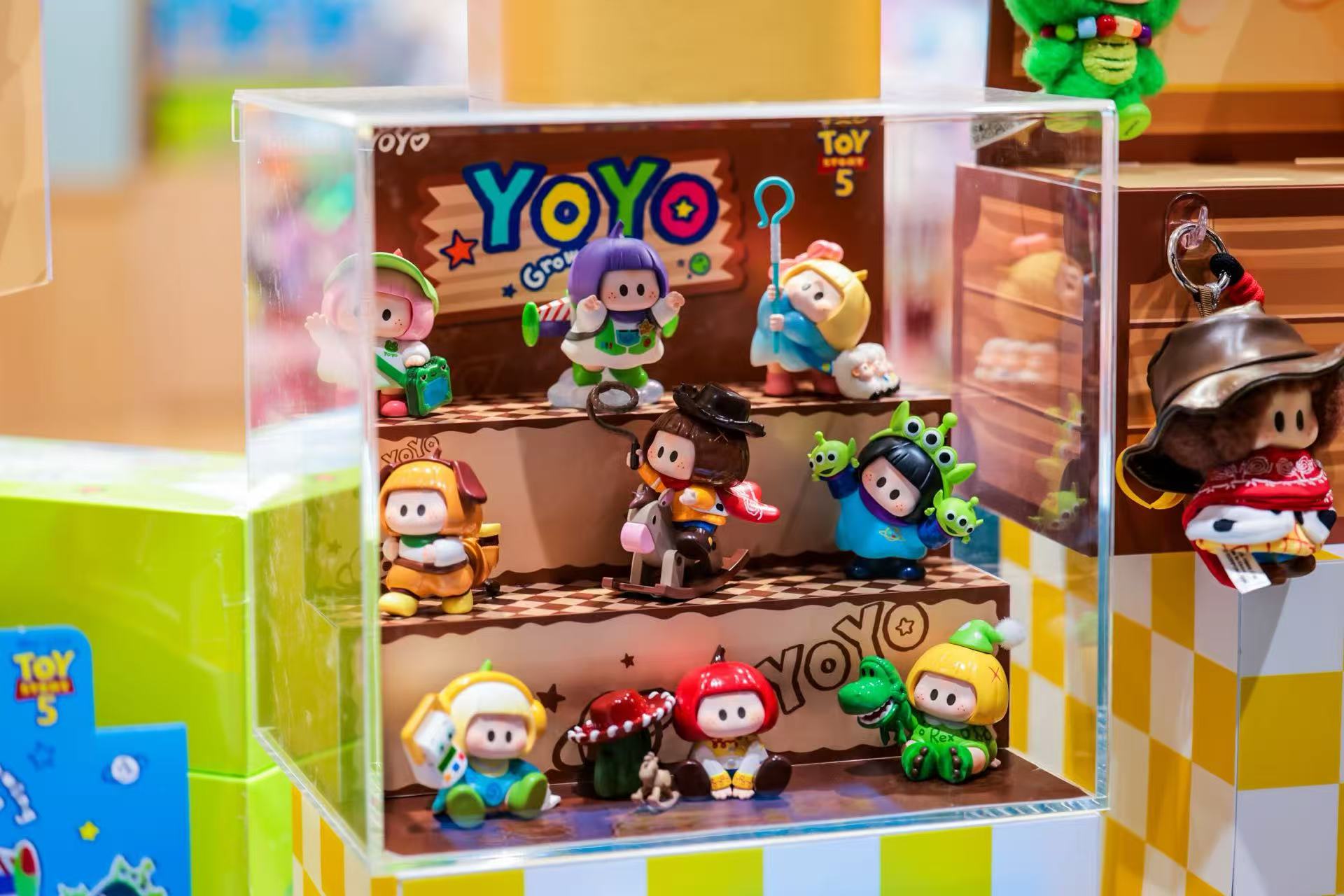
The Yoyo character is the specific product experiment underneath the broader strategic bet. Miniso's first original character launched in June 2025 and generated RMB 100 million, about USD 14.7 million, in sales within six months, primarily in the Chinese market. Liu expects Yoyo to reach roughly RMB 800 million, about USD 117.8 million, in revenue this year. That trajectory is not Labubu-scale yet, but it is fast growth from a standing start. It also demonstrates that Miniso's supply chain, retail distribution, and marketing infrastructure can push an owned character into the RMB 100 million range within six months of launch. That specific capability is the operational asset the company is now scaling by signing artists at pace. If any of the 30 signed artists produces a character that resonates the way Labubu did, Miniso's existing infrastructure can amplify the resulting demand faster than most competitors could match.
The US expansion is the other half of the strategic move, and the specific tactics are worth studying. Miniso plans to open 100 US stores this year, expanding its US footprint by 20 percent to a total of about 380 stores. The company is deliberately shifting away from traditional shopping mall placements and moving toward strip malls and street-front locations. It is launching three experiential stores in Las Vegas, Columbus, and East Rutherford, featuring interactive attractions such as claw machines. The Grand Central Station Yoyo sculpture exhibition in June was designed as a brand awareness campaign to introduce the Miniso character IP to US consumers. Each of these tactics is deliberately borrowing from the immersive retail concept that has boosted Miniso's Chinese sales, adapted for the US retail environment. The strategic frame is that immersive retail is Miniso's structural advantage against traditional US discount retailers who cannot match the experiential store design at the same price points.
The Editor's Note
If you are reading this and the pattern fits your business, start the conversation before the conversation starts itself. editor@unpublished.my.
The trade press caution on Miniso's IP strategy is worth reading directly. Loo Wee Teck, Euromonitor's global insight manager for toys and games, noted that many characters get released to the market but few reach the widespread cultural resonance that Labubu achieved. Miniso can compete on distribution and price, Loo said, but building a character with lasting global appeal is a much harder challenge. Lina Yan, HSBC's consumer analyst, added that Pop Mart took nearly two decades to scale one of its other characters to the RMB 3 billion revenue level Labubu reached in 2025. That timeline caution is the specific reality check the Miniso strategy runs against. Even with 30 signed artists, an established retail network, and an operational supply chain optimised for character merchandise, the character breakout is a probabilistic outcome that requires a specific alchemy of design, cultural timing, and consumer psychology that no combination of supply chain investment guarantees. The strategy is credible. The specific character breakout is not predictable.
For the Malaysian and broader Southeast Asian retail operator, four implications run from this story.
One. The shift from licensed IP to owned IP is a category-wide movement, not a Miniso-specific move. Every major Chinese consumer discretionary operator is now building character portfolios, artist relationships, and IP development capabilities. That means over the next thirty-six months, the specialty retail category will fragment into two positions. Operators who own their IP will command higher margins and retain the enterprise value that character franchises produce. Operators who rely on licensed IP will remain profitable but structurally capped at the margin the licensor allows them to keep. Malaysian retail operators should be evaluating which position they currently occupy and which position they want to be occupying in five years.
Two. The Malaysian character design ecosystem is currently underused for the category opportunity that is developing. Southeast Asian character designers, particularly from Thailand and the Philippines, have been producing culturally distinctive designs that could support the same IP-driven retail model that Pop Mart and Miniso are scaling. Malaysian retailers with sufficient scale to sign character artists (Aeon, Village Grocer, and even the mall developers themselves) should be evaluating whether they can build owned character portfolios that would produce equivalent margin structures to what Miniso is achieving. The specific move is not to license the finished character. The specific move is to sign the artist during development and share revenue on the resulting character franchise.
Three. The immersive retail transition is the store-level operational shift Malaysian retailers should be preparing for. Miniso's US strategy is explicitly built on immersive retail concepts (claw machines, character sculptures, interactive attractions) that transform the store visit into a content-generating event. Malaysian retailers positioned in Pavilion, Mid Valley, Suria KLCC, and the TRX developments should be evaluating whether their current store designs support the same category of experiential retail, or whether the stores need to be redesigned to compete for consumer attention against operators like Miniso who are structurally optimised for the immersive retail category.
Four. The Southeast Asian retail comparison Miniso is not making is with its regional competitors like Muji, Daiso, and various local Malaysian discount lifestyle retailers. Muji has established Japanese design credibility. Daiso has established Japanese price-point credibility. Local Malaysian discount retailers have established price-point positioning but not design credibility. Miniso's advantage over the Malaysian competitors is the character IP that none of the domestic operators are currently building. That advantage compounds over time. The Malaysian retail operators who want to compete against Miniso's expansion in the region should be reading the Yoyo trajectory as a specific competitive threat and building their own character IP investment now, not after the Miniso positioning has consolidated.
The headline is a Chinese retailer opening US stores and signing artists. The story is the categorical shift from licensed IP to owned IP that is quietly restructuring the economics of specialty retail across the Asia-Pacific region. The Malaysian retail operator who reads the store count is reading the wrong version. The right version asks which position on the licensed-versus-owned IP spectrum the operator currently occupies, and what strategic investments would be required to move to a more valuable position before the competitive dynamics harden.