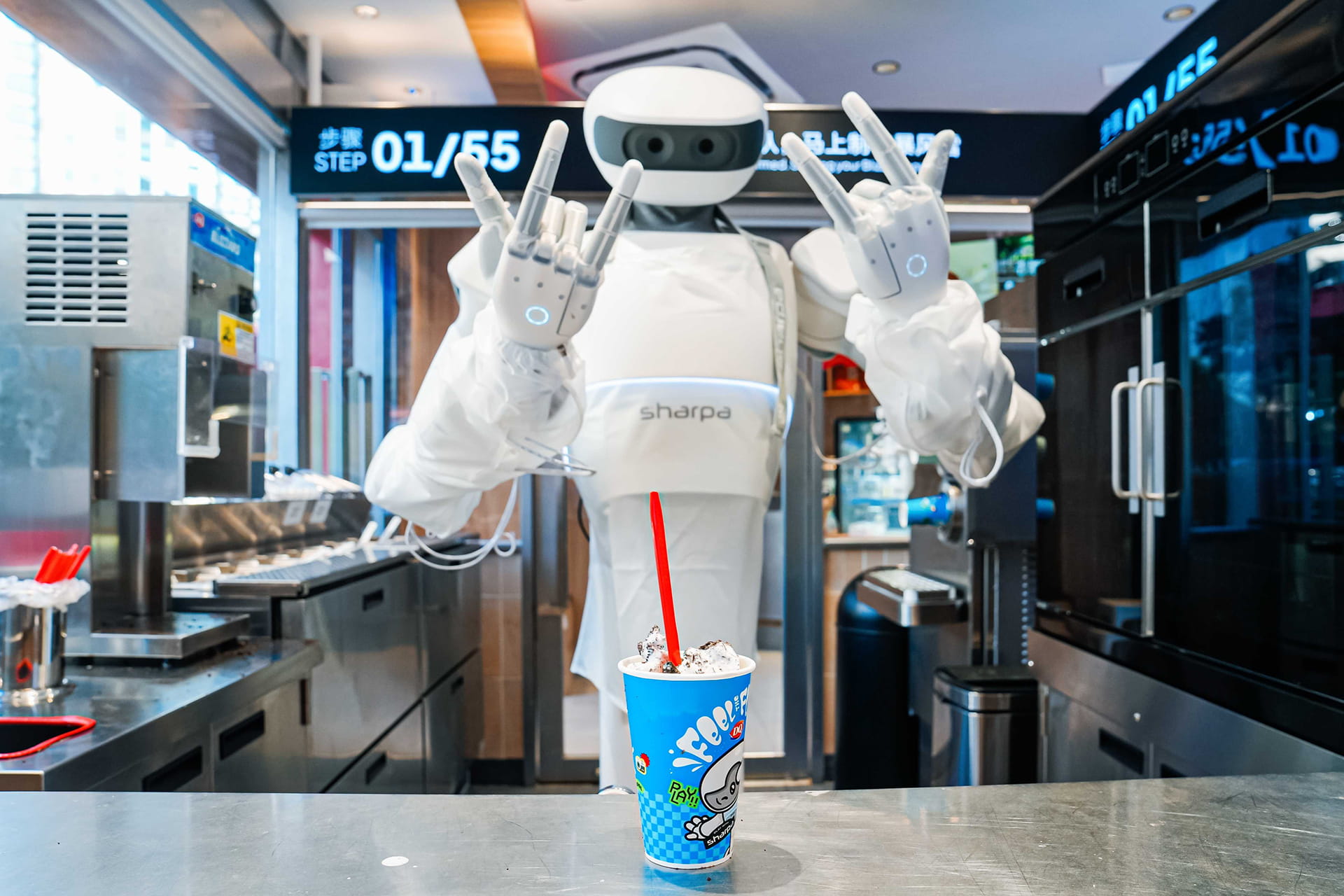
The commercial robotics category has spent the past decade producing an almost continuous stream of impressive demonstrations that failed to translate into durable commercial deployment. Robotic baristas, robotic burger flippers, robotic pizza makers, and robotic sushi chefs have all appeared in various markets over the past ten years, generated press coverage, and then quietly disappeared from operating locations when the operational economics did not sustain themselves. The specific structural reason for the pattern is that most previous restaurant robotics deployments required the restaurant to be redesigned around the robot: custom equipment, custom ingredients, custom workflows, and custom staff training that fundamentally changed the operating model of the location. Once the restaurant reverted to its normal operating pattern, the robot became redundant or actively obstructive. The specific breakthrough that Sharpa is claiming with its Dairy Queen deployment is that the robot works inside the existing restaurant operating pattern without requiring any of those modifications.
Sharpa is the Singapore-founded robotics startup, linked to Hesai Technology's founders, that has moved fastest to establish position at the specific intersection of dexterous manipulation and commercial deployment. The company has raised more than RMB 4.5 billion (about USD 668 million) at RMB 22 billion (about USD 3.3 billion) post-money valuation in its most recent funding round. The investor list includes Alibaba, Meituan, Tencent, JD.com, and Transsion as strategic corporate investors, along with HSG, Qiming Venture Partners, DragonBall Capital, and Luminous Ventures as financial investors. That specific investor mix (four of China's largest consumer platform companies plus experienced financial investors) signals that Sharpa's technical approach is being taken seriously as a strategic asset for the consumer-facing operators that would eventually deploy the technology at scale across their own operations.
The Dairy Queen deployment is the specific commercial test that Sharpa has chosen to validate its technical approach. On August 29, Sharpa and Dairy Queen (operating in China through CFB Group) jointly opened what they describe as the world's first restaurant capable of year-round autonomous robotic operation without modifications to the existing store environment. The deployment is at DQ's Wujiang Road outlet in Shanghai. The robot handles the entire 55-step process for fulfilling a Blizzard Treat order, from receiving the order through preparing the dessert to handing it to the customer. The specific operating hours are 10 a.m. to 10 p.m., without continuous human control. That specific test condition (12-hour continuous operation on a standard restaurant workflow using standard equipment) is materially different from the demonstration deployments that previous robotics operators have executed. The specific difference is whether the robot can produce consistent economic value rather than simply demonstrate technical capability.
The technical architecture underneath Sharpa's approach is worth reading precisely because it explains why the zero-retrofit standard is achievable at all. The robot uses the same standardised equipment, ingredients, tools, and procedures already used by human employees. The Sharpa Wave dexterous hand is modelled on the size, form, and degrees of freedom of the human hand, which allows it to manipulate cups, cabinet doors, and spoons without requiring specialised tools. The company breaks the 55-step workflow into smaller subtasks that can be planned, checked, and repeated when necessary, so that small errors do not accumulate across the full sequence. After each stage, the system evaluates the resulting state, and if the outcome differs from expected, the robot retries the action or performs an error-recovery procedure. That specific loop of planning, execution, verification, and correction is what enables long-horizon workflows in commercial environments where conditions change over time.
The Editor's Note
If you are reading this and the pattern fits your business, start the conversation before the conversation starts itself. editor@unpublished.my.
The tactile sensing capability is worth reading precisely because it is the specific technical layer that most previous restaurant robotics deployments did not solve adequately. Sharpa says tactile sensing is involved in 98 percent of the 55 steps in the Blizzard workflow. Pulling out a paper cup requires the robot to respond to friction and resistance. During high-speed mixing, it must adjust its grip as vibration and force change. Performing DQ's signature upside-down flip requires the system to adapt as the cup's orientation and centre of gravity shift. Each of these specific manipulations depends on force feedback and finger position adjustment that visual sensing alone cannot provide. CraftNet, Sharpa's internally developed hierarchical end-to-end model, incorporates tactile inputs. Combined with the multi-finger Sharpa Wave robotic hand, the system adjusts finger position and applied force in response to tactile and force feedback. That specific capability is what enables the robot to work with soft cups, viscous ice cream mixtures, and other physically variable materials that previous commercial robots have handled poorly.
The strategic frame Li Yifan articulated to the Chinese trade press is worth reading precisely. Li said commercialising robots requires them to perform complex work over long periods and across changing situations without requiring environments to be redesigned around them. Sharpa chose a restaurant as an early test of whether those capabilities can transfer to other commercial settings. The longer-term ambition is to reuse the same technology stack across different commercial environments: food service, other commercial service applications, and eventually household deployment. That specific commercial trajectory (food service now, other commercial services next, household eventually) is the specific commercial roadmap that Malaysian operators considering robotic deployment should be evaluating against. Operators who wait for the household deployment version to arrive will be operating against competitors who have already accumulated years of operational data from the earlier commercial deployment phases.
For the Malaysian and broader Southeast Asian operator, four implications run from this story.
One. The Malaysian F&B chain operator should be reading Sharpa's zero-retrofit standard as the specific deployment threshold that separates commercially viable restaurant robotics from expensive pilots. Any robotics operator approaching Malaysian F&B chains with proposals that require store redesign, custom equipment, or workflow modification should be evaluated against the specific Sharpa standard. Proposals that do not meet the zero-retrofit standard are unlikely to produce durable commercial deployment. Malaysian F&B chains should be requesting the specific Sharpa comparison as part of their evaluation criteria for any robotics vendor.
Two. The Malaysian labour policy conversation should be reading the specific 55-step workflow completion as the operational capability that changes the labour economics of restaurant operations. Restaurant labour shortages have been a persistent operational problem across Malaysian F&B for the past decade, particularly for the specific roles (order preparation, ingredient handling, mixing operations) that Sharpa's technology addresses. The Ministry of Human Resources should be evaluating whether Malaysia's labour policy framework accommodates or resists the specific type of workflow automation that Sharpa demonstrates. The policy framework will shape whether Malaysian F&B operators can deploy the technology as it becomes commercially available, or whether the deployment happens first in competing regional markets.
Three. The Malaysian equipment supplier to the F&B category has a specific commercial opportunity to design equipment that is compatible with the emerging robotic manipulation standard. Sharpa's zero-retrofit approach depends on the underlying equipment being designed for human ergonomic patterns that transfer to robotic manipulation. Malaysian F&B equipment suppliers who design their next-generation product lines with explicit robotic compatibility (specific handle geometries, specific spatial layouts, specific force tolerance patterns) will be positioned as preferred suppliers for the robotic-augmented F&B operators that will emerge across the region over the next thirty-six months.
Four. The Malaysian franchise operator should be reading the Dairy Queen deployment as a specific validation that global franchise brands are actively piloting restaurant robotics in their Chinese operations. Franchise brands including Dairy Queen, McDonald's, KFC, Starbucks, and various regional operators are running parallel pilots in China that will inform their global deployment decisions. Malaysian franchisees of these brands should be positioning to be the specific market where their franchise brand extends the Chinese pilots first. The specific commercial move is to establish direct communication with the franchise brand's technology and operations teams about Malaysian market readiness for the robotic deployment, before the franchise brand makes the extension decisions without Malaysian input.
The headline is a Chinese robotics startup raising USD 668 million and deploying at Dairy Queen. The story is the specific technical breakthrough (zero-retrofit deployment, autonomous long-horizon workflow completion, reliable multi-hour operation) that changes the commercial economics of restaurant robotics for the first time in the category's history. The Malaysian F&B operator who reads the deployment as a technology demonstration is reading the wrong version. The right version asks which specific operational and strategic decisions need to be made in the next eighteen months to position Malaysian F&B for the wave of commercial robotics deployment that will follow the Sharpa reference case.