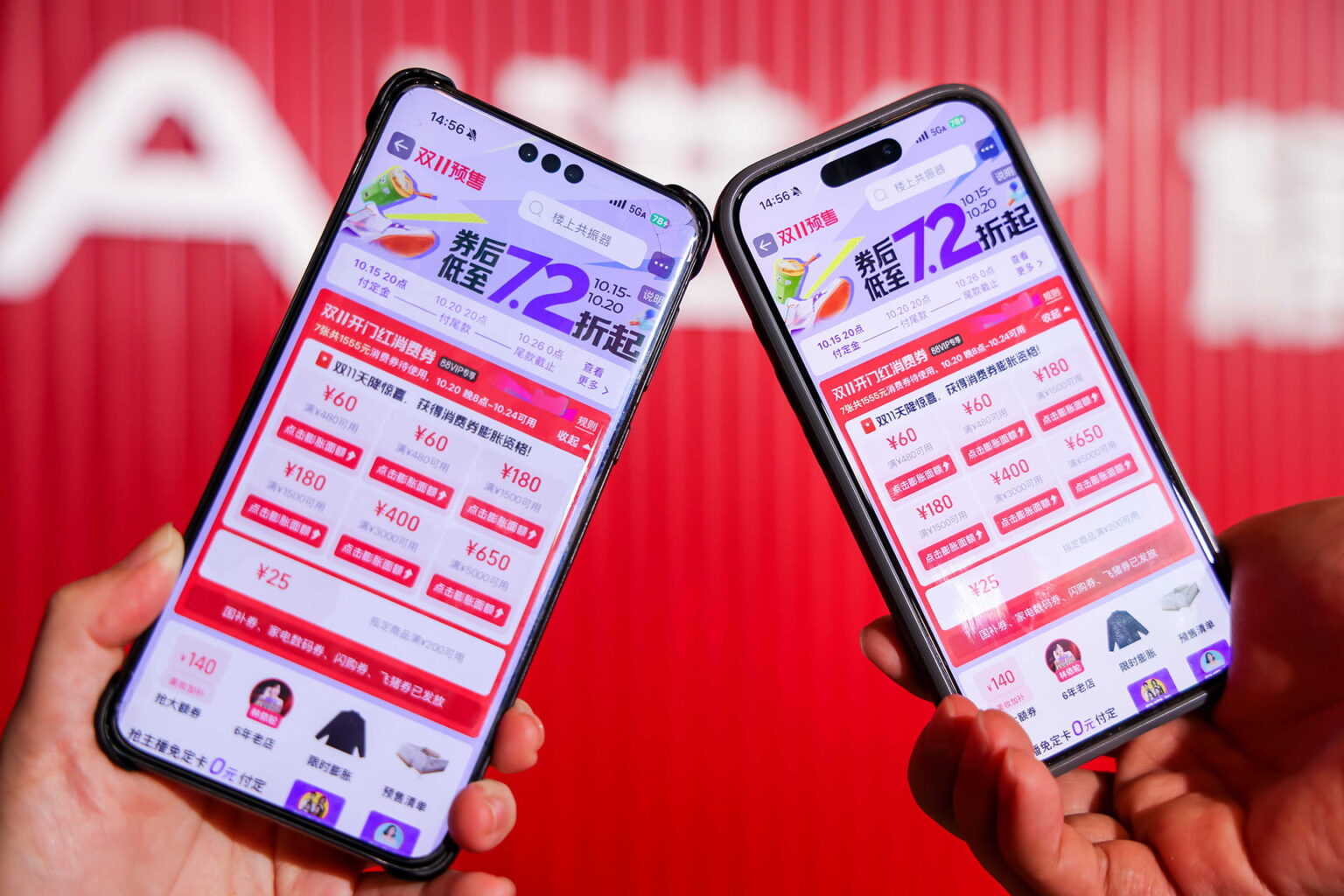
The screens in the photograph tell the story Alibaba wants told. Two phones are held up against a wall of Tmall red, both open on the Singles' Day presale page. The banner promises prices as low as 28 percent off after coupons. Below it sits a stack of seven consumption coupons worth RMB 1,555 in total: RMB 60 off a RMB 480 spend, RMB 180 off RMB 1,500, RMB 400 off RMB 3,000, RMB 650 off RMB 5,000. The timeline runs from deposits on the evening of 15 October to final payment from 20 October. Every one of those coupons is a threshold. The discount exists only if the shopper spends more than they planned. In the language of retail, a coupon is a polite name for a minimum order.
The headline numbers are bigger than ever. Tmall says a record one million global brands and more than 70 million products will take part in this year's festival. Presales began on 15 October, and the main event starts at 8pm China time on 20 October. Liu Bo, president of Tmall, said the platform is working with brands to respond to shifting consumer needs and to use new technology, including AI, and he described Tmall flagship stores as the central place for brands to capture their biggest growth opportunity of the year.
What Alibaba does not publish is just as telling. The company stopped releasing a single Singles' Day sales total years ago, and last year it again declined to disclose one. It offered other numbers instead. About 600 brands passed RMB 100 million in transactions, 13,081 brands grew more than fivefold, and Apple, Huawei, Xiaomi and Nike each crossed RMB 1 billion. Third-party estimates from Xingtu Data put total sales across all Chinese platforms at RMB 1.695 trillion, up 14.2 percent, but the sales windows were longer than the year before, which makes the real growth hard to read. Consumers were noticeably calmer. Average discounts held at roughly 15 to 17 percent, and complaints about promotion complexity rose from 7 percent to 31 percent. When the total stops growing in a way you can show, you change the scoreboard.
This year's scoreboard is about supply. Merchants launching new products on Taobao and Tmall rose 64 percent year-on-year in the run-up to the festival. Brands are expected to introduce about 50,000 key products and more than 2,000 items sold only on Tmall. Around 60,000 merchants are joining Singles' Day for the first time, among them Alo, the Los Angeles fashion and athleisure brand, which opened its first online store in China on Tmall in August. Apple is using the event to debut its first foldable smartphone, the iPhone Duo, on Tmall, while buyers of the iPhone 18 Pro can apply platform discounts. Tmall has been directing more resources toward merchants with differentiated products, expanding support for launches and trying to ease the price wars that Chinese commerce calls involution. The message to brands is plain. Come with something new, not just something cheaper.
The Editor's Note
If you are reading this and the pattern fits your business, start the conversation before the conversation starts itself. editor@unpublished.my.
Singles' Day is also no longer a day. Last year Tmall and Taobao ran their festival from 15 October to 14 November, three days longer than the year before. JD.com started on 9 October, and Douyin opened its campaign in mid-September, a full 22 days earlier than in 2024. Pinduoduo kept to its everyday low-price positioning. The result is a two-month season in which every platform competes for the same wallets, and in which a single headline sales number means less each year. In a long season, the platform that wins is not the one with the deepest one-day discount. It is the one that gives shoppers a reason to come back several times: a new launch, an exclusive, a member-only coupon. That is the competitive logic behind Tmall's emphasis on supply.
The money behind the message goes to members. 88VIP, Alibaba's paid membership programme, had about 64 million members as of June, up by double digits year-on-year, and Tmall calls them its highest-spending customers. Last year Alibaba committed RMB 5 billion to 88VIP subsidies. This year it is offering flexible coupons designed to pull those members into the festival. The logic is the loyalty economics every airline understands. A subsidy spread across a billion shoppers buys little. The same subsidy concentrated on the people who already spend the most buys repeat purchases and protects brand prices for everyone else. The coupon wall in the photograph carries an 88VIP badge for a reason.
The quieter change is in how shoppers choose. In May, Alibaba connected its Qwen AI app to the product catalogues of Taobao and Tmall. The assistant compares products, lets users try on clothing virtually and surfaces promotions, and it is part of a wider push to embed AI in the transaction itself, moving beyond recommendations to helping shoppers decide and pay. Alibaba's own AI revenue story has so far been about cloud. This is where it meets the consumer. A shopping assistant reads product data, reviews and specifications, not mood boards. A brand that is clearly different survives that reading. A brand whose only argument is price becomes a line in a comparison table, and the assistant will always find a cheaper line.
For the Malaysian operator, three implications follow.
One. Malaysian brands selling into China should enter with a launch, not a markdown. Bird's nest, durian products, skincare, snacks and coffee all reach Chinese shoppers through Tmall Global and cross-border channels. The platform has now said, in numbers, that it is rewarding new products, exclusives and flagship stores. A Malaysian brand arriving for Singles' Day with nothing but a deeper discount is fighting the direction of the platform. A Malaysian brand arriving with a Tmall-exclusive pack size, a festival-only flavour or a limited edition is swimming with it.
Two. Watch Lazada for the same playbook. Alibaba controls Lazada, and Malaysia's own 11.11 is fought mainly on Lazada and Shopee. Paid membership, threshold coupons and AI-assisted shopping are tested at scale in Hangzhou before they spread. It would be unusual if this one did not travel. Malaysian sellers on regional platforms should be preparing now for a world where the best traffic goes to members and to products an AI assistant can clearly describe, and where blanket discounting buys less attention every year.
Three. Fix the product data before the robots read it. When a shopping assistant sits between the customer and the shelf, the quality of a brand's product titles, attributes, photographs and reviews becomes a sales channel in its own right. Most Malaysian SME listings were written for a human scrolling at speed. They will be read by a machine that compares ingredients, sizes, certifications and prices in a single pass. Halal certification, origin, specifications and use cases need to be stated clearly, consistently and in the language of the market being sold to.
The headline is a bigger number of brands. The business underneath is a platform telling its merchants that price is no longer enough, and putting its subsidies and its AI behind that instruction. Singles' Day has always been read as China's discount barometer. This year it reads more like a product launch calendar with a sale attached.