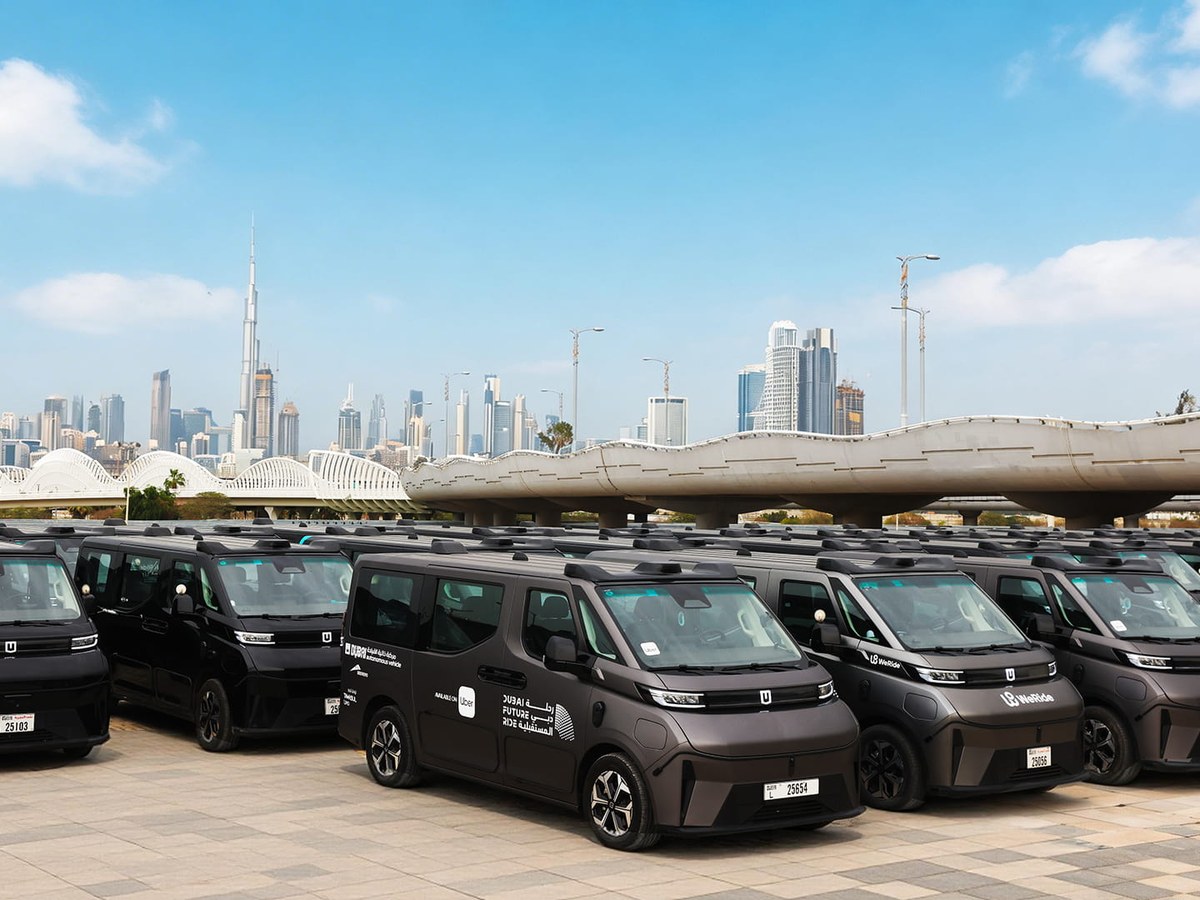
WeRide, the Nasdaq-listed autonomous driving company, reported first-quarter 2026 results on 13 May. Total revenue of RMB 114.1 million, approximately USD 16.8 million, up 57.6 percent year-on-year. Product revenue, mostly from Level 4 vehicle sales including robotaxis, rose 115.8 percent. Service revenue rose 49 percent, driven by intelligent data services and driving assistance contracts. Gross margin held at 34.7 percent. Operating loss narrowed slightly to RMB 431 million.
Goldman Sachs initiated coverage with a buy rating and a price target of HKD 54.23. Huatai Securities reiterated its buy rating at HKD 50. Both cited the same structural thesis. WeRide is positioned to capture share in the next wave of robotaxi deployment, particularly in markets where regulatory environments are receptive and incumbent ride-hailing infrastructure is willing to partner.
The financial numbers are not the story. The geographic numbers are.
As of Q1 2026, WeRide is operating across more than 40 cities in 12 countries. The robotaxi fleet in China exceeds 1,000 vehicles. Registered users of the China robotaxi service approximately doubled year-on-year. Average daily orders per vehicle in China exceeded 17, rising to 28 during peak periods. These are not pilot numbers. These are operational utilisation numbers comparable to what a conventional taxi fleet would generate.
Internationally, the deployments are happening in specific corridors that signal where the next wave will land first. Dubai and Abu Dhabi have fully driverless commercial robotaxi operations. Singapore launched public robotaxi service in April through a partnership with Grab in the Punggol district. WeRide is reportedly the only company currently approved to conduct public autonomous passenger operations in Singapore. Switzerland approved removal of the safety operator from WeRide's robobus at Zurich Airport, another step toward fully driverless commercial deployment. Slovakia became WeRide's fourth European market in March, after France, Belgium, and Switzerland.
Map this geographic pattern carefully. Dubai. Abu Dhabi. Singapore. Switzerland. Western Europe. These are the markets where the regulatory environment has moved fastest, the public infrastructure is highest quality, and the political appetite for autonomous mobility deployment is strongest. They are also markets where conventional taxi and ride-hailing economics are expensive enough that the unit economics of robotaxis penetrate quickly.
Malaysia is not on the list. Neither is Indonesia. Neither is Thailand. Neither is the Philippines. Vietnam is exploring it. The Southeast Asian markets that conventional ride-hailing dominated through Grab, Gojek, and inDrive are not where the next-generation autonomous version is landing first.
This is the part Malaysian transport operators, urban planners, and ride-hailing competitors should be reading carefully. The robotaxi rollout is happening on a faster timeline than most regional operators are modelling for. The five-year deployment plan WeRide announced in partnership with Lenovo targets 200,000 robotaxis and other autonomous vehicles globally. That deployment will arrive in Southeast Asia in waves. The first wave is hitting Singapore in 2026. The next waves will follow as regulatory frameworks catch up.
The Editor's Note
If you are reading this and the pattern fits your business, start the conversation before the conversation starts itself. editor@unpublished.my.
When robotaxis arrive at scale in Kuala Lumpur, Bangkok, Jakarta, or Manila, the operational economics of conventional ride-hailing change permanently. The driver cost, which represents the largest single line item in a Grab or Bolt unit economics model, goes to zero. The fleet investment cost rises substantially. The capital structure of the dominant operators has to reorganise. The drivers who currently depend on ride-hailing income for primary or secondary earnings face displacement on a timeline that policy frameworks across the region are not yet preparing for.
WeRide's WRD 3.0 advanced driver assistance solution is the other half of this story. It has been adapted for Nvidia Drive, Qualcomm Snapdragon, and SemiDrive X9 platforms, covering the full range of in-vehicle computing options that global OEMs are designing around. WRD 3.0 has secured design wins for nearly 30 vehicle models across GAC Group and Chery, with planned expansion to Tiggo, Lepas, Omoda, and Jaecoo. The Aion N60, developed jointly by WeRide and GAC Aion, went on sale in April as WeRide's first mass production deployment on the Qualcomm Snapdragon platform.
What this means is that even before the robotaxi fleet arrives in volume in a given market, the underlying autonomous driving software is being licensed into the passenger vehicles already on the road. The progression from Level 2 advanced driver assistance to Level 4 autonomous operation is happening as a continuous capability ladder, not a discrete category shift. The car your customer drove to your store last year and the car your customer will ride in five years from now are both running variations of the same underlying autonomy stack.
WeRide also disclosed WeRide Genesis, a world model designed to simulate diverse driving scenarios for training. According to the company, Genesis can improve the efficiency of data collection and training for long-tail edge cases by thousands of times compared with traditional road testing, while reducing data collection and labelling costs by 75 percent. This is the kind of infrastructure investment that compounds over time and that makes the gap between the leaders and the followers in autonomy progressively harder to close.
Malaysian and regional Southeast Asian operators reading this should be doing two things. One, modelling what their transportation-related business looks like at 30 percent robotaxi penetration in their local market, a number that is realistic for KL or Bangkok by 2030 to 2032 based on the current deployment trajectory. Two, identifying which adjacencies, fleet management, charging infrastructure, vehicle servicing, software integration, become economically attractive as the autonomy stack arrives. The companies that build those positions before the deployment happens will be the suppliers and partners the operators have to use when they get to local market scale.
WeRide is a Chinese company headquartered in Guangzhou, listed on Nasdaq, deployed in twelve countries, financially scaling, and operationally trusted by the most selective regulatory environments in the world. That combination is the template for the next wave of Asian deep-tech companies. The question for Southeast Asian operators is whether the next regional WeRide-equivalent gets built locally or whether the existing Chinese leaders absorb the regional opportunity entirely on their existing infrastructure. The window for that decision is closing faster than the local trade press is documenting.