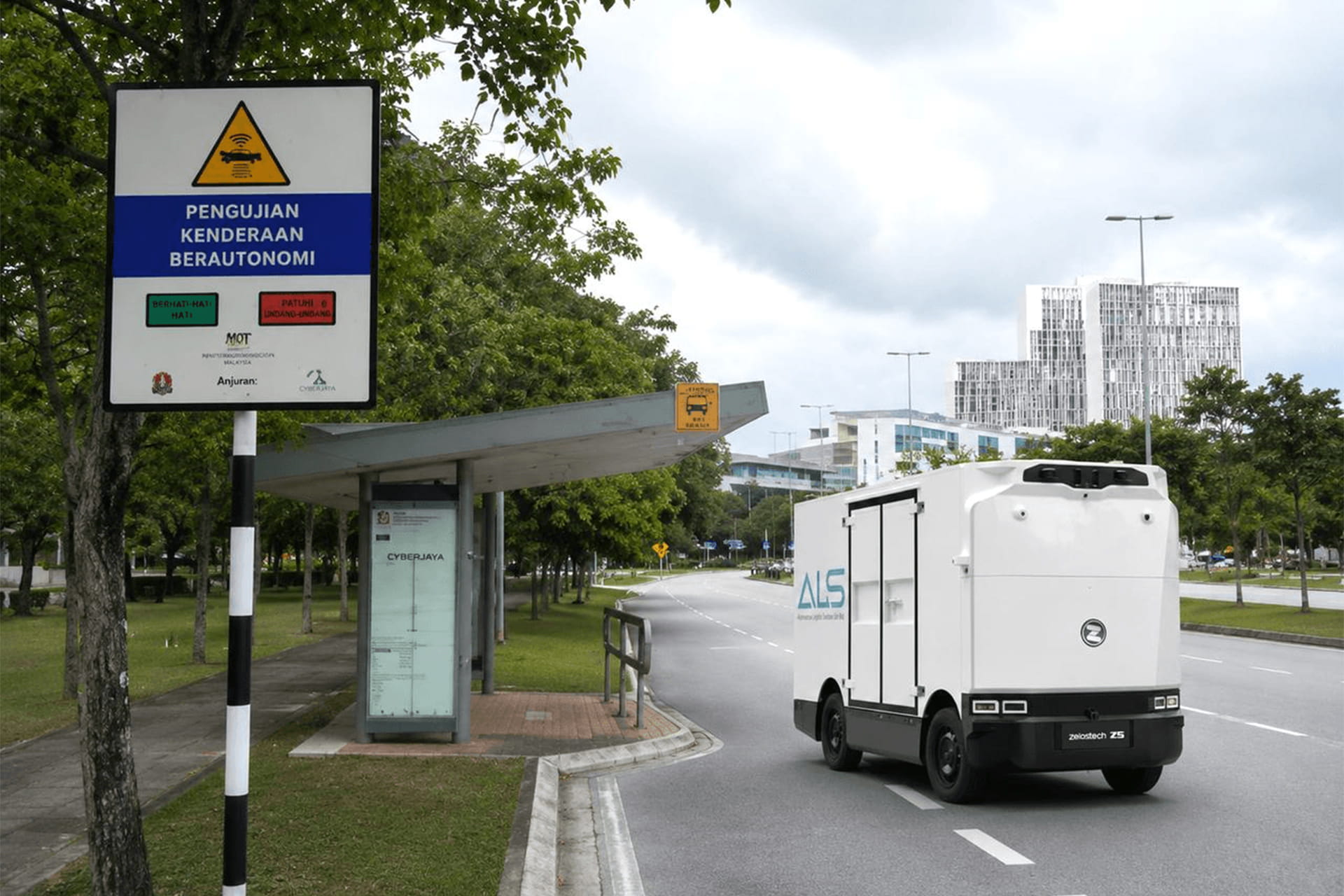
On June 30, the Malaysian Ministry of Transport approved the country's first dedicated public road trial license plate for a Level 4 autonomous logistics vehicle. Level 4 in the autonomous driving industry hierarchy is the classification that describes vehicles which handle all driving tasks within limited service areas without requiring a human driver to be engaged. The license was issued to Zelostech (short for Zelos Technology), a Chinese autonomous logistics vehicle company operating in Malaysia through a partnership with local operator Autonomous Logistic Solutions, or ALS, and postal operator Pos Malaysia. The trade press coverage has treated this as a Malaysia-specific development, which is directionally correct but strategically incomplete. The much more consequential story is what Zelostech has been doing simultaneously in Singapore, and what that simultaneous positioning implies about the terms under which Malaysia has just received its Level 4 licensing precedent.
Zelostech's Malaysian operation started in January 2026 with a joint proof of concept alongside ALS and Pos Malaysia at Pos Malaysia's national mail centre. That phased trial completed more than one thousand kilometres of autonomous operations in a controlled environment. The project logged thirty-six consecutive days without accidents or operational incidents. Based on those validation results, the Ministry of Transport approved the country's first Level 4 public road trial license, and Zelostech's robovan is now expected to begin public road testing in Cyberjaya over the next three to six months. Read past the trial framing and what has been demonstrated is a specific Malaysian regulatory precedent. The Ministry of Transport has established that a controlled six-month proof of concept, supported by a Malaysian operating partner, produces a public road license. That precedent will now be the reference framework for every subsequent Chinese autonomous logistics operator that seeks Malaysian public road access. Zelostech has set the terms.
The Changi Airport deployment is the piece that changes how the Malaysian license should be read. Zelostech and Eevie have launched an autonomous cargo vehicle deployment inside the Changi Airport Free Trade Zone, using the same Z5 autonomous cargo vehicle to connect ground handling, cargo consolidation, freight forwarding, and related airport logistics operations. The Changi project is a multi-node logistics integration system, not a single point-to-point transport pilot. It connects air cargo terminal operations facilities, the logistics consolidation hub, and selected freight forwarder warehouse operations, integrating aviation operations systems, ground handling systems, and Zelostech's own autonomous driving system across the logistics chain. That is a materially more complex deployment than the Malaysian Cyberjaya trial, and it is happening simultaneously with the Malaysian licensing process. The strategic implication is that Zelostech is treating Southeast Asia as a coordinated regional deployment, not as a series of country-specific pilots. Whatever operational capabilities the company builds in Singapore will be applied in Malaysia. Whatever regulatory relationships the company builds in Malaysia will inform its approach to Thailand and Indonesia. The Malaysian license is one node in a regional autonomous logistics network that Zelostech is building deliberately.
The ALS partnership is the specific Malaysian detail that deserves closer reading. Autonomous Logistic Solutions is a Malaysian-registered entity positioned as the domestic operator through which Zelostech is deploying its Malaysian operations. That structure allows Zelostech to satisfy Malaysian regulatory requirements for local partnership and technology transfer while retaining ownership of the underlying autonomous driving technology and the operational IP that comes from public road deployment data. The specific terms of the ALS-Zelostech partnership have not been publicly disclosed. Those terms determine what Malaysia actually gets out of hosting the first Level 4 autonomous logistics deployment. Terms favourable to Malaysia would include data ownership sharing, technology transfer commitments, local engineering hiring targets, and preferential procurement for Malaysian suppliers within the deployment supply chain. Terms unfavourable to Malaysia would include most of those categories being retained by the Chinese principal. The Malaysian Ministry of Transport and the Malaysian Investment Development Authority should have made those terms explicit before approving the license, and if they did not, the specific gap needs to be reviewed before the second Level 4 license gets issued.
The Editor's Note
If you are reading this and the pattern fits your business, start the conversation before the conversation starts itself. editor@unpublished.my.
The Changi Airport model is also the one Malaysian airport operators should be reading. The Zelostech deployment at Changi is designed as a multi-node logistics integration system that connects aviation operators, logistics service providers, and autonomous driving technology systems through a shared operating framework. That model is directly applicable to KLIA, Penang International Airport, Kota Kinabalu, and Kuching. The specific operational asset (a coordinated autonomous logistics network across airport landside operations) is worth meaningfully more to airport operators than a single autonomous vehicle deployment at any one node. The Malaysia Airports Holdings Berhad decision on whether to pursue an equivalent deployment at KLIA, and on what terms, is a decision that needs to be made in the next twelve to eighteen months, before the Changi model becomes the reference precedent that Chinese autonomous logistics operators use to set terms for the region.
For the Malaysian and broader Southeast Asian logistics operator, four implications run from this story.
One. The Level 4 license precedent has now been set on specific terms, and every subsequent applicant will operate against those terms. Whatever the ALS-Zelostech partnership contains as commitments on data ownership, technology transfer, local hiring, and supplier development is now the effective floor for Malaysian regulatory expectations. Malaysian logistics operators considering their own autonomous vehicle deployment plans should be requesting a public briefing on the ALS-Zelostech commercial terms, so that competing applications can be structured with equivalent or better commitments to Malaysian industrial development.
Two. The airport deployment model is the specific opportunity Malaysia Airports Holdings should be studying. Zelostech's Changi Airport deployment demonstrates that airport landside logistics can be integrated across multiple operators using a shared autonomous vehicle framework. KLIA's landside logistics currently operate as fragmented systems across multiple ground handling providers, cargo terminal operators, and freight forwarders. Consolidating that fragmentation through a coordinated autonomous vehicle deployment would produce operational efficiency gains that MAHB has been trying to capture through less structural means for years. The specific vendor selection (Zelostech, an established competitor, or a domestic consortium) is a strategic decision. The decision to pursue the model is now unavoidable.
Three. Pos Malaysia's positioning as the deployment partner is the strategic asset the Malaysian government should be pricing carefully. Pos Malaysia hosted the initial proof of concept and provided the operational context that produced the Level 4 license. That role gives Pos Malaysia early operational data, direct exposure to the technology stack, and negotiating leverage for the next generation of autonomous logistics deployments the company will be involved in. The Pos Malaysia board should be evaluating whether the current commercial arrangement captures the strategic value the company has provided, or whether the arrangement needs restructuring to reflect the precedent-setting nature of the deployment.
Four. The Malaysian autonomous vehicle operator that positions to compete for the next licenses has approximately eighteen months of window. Zelostech has set the Level 4 precedent. WeRide, Pony.ai, CaoCao, Baidu Apollo Go, and several other Chinese autonomous mobility operators will be applying for equivalent Malaysian licenses over the next twelve to twenty-four months. Malaysian operators who want to participate in that build-out, either as local partners for foreign operators or as domestic principals developing their own autonomous vehicle capability, have approximately eighteen months to establish credibility before the market positioning solidifies. After that, the terms will be set by whoever secures the reference partnerships first.
The headline is Malaysia's first Level 4 autonomous logistics vehicle license. The story is that Malaysia has just accepted the Zelostech deployment framework as its reference precedent for autonomous vehicle licensing, without a public discussion of whether the underlying commercial terms serve Malaysian industrial policy objectives. The Malaysian logistics operator who reads the license announcement is reading the wrong version. The right version asks what specific concessions Malaysia extracted, or failed to extract, and whether those concessions can be improved before the next license is issued.