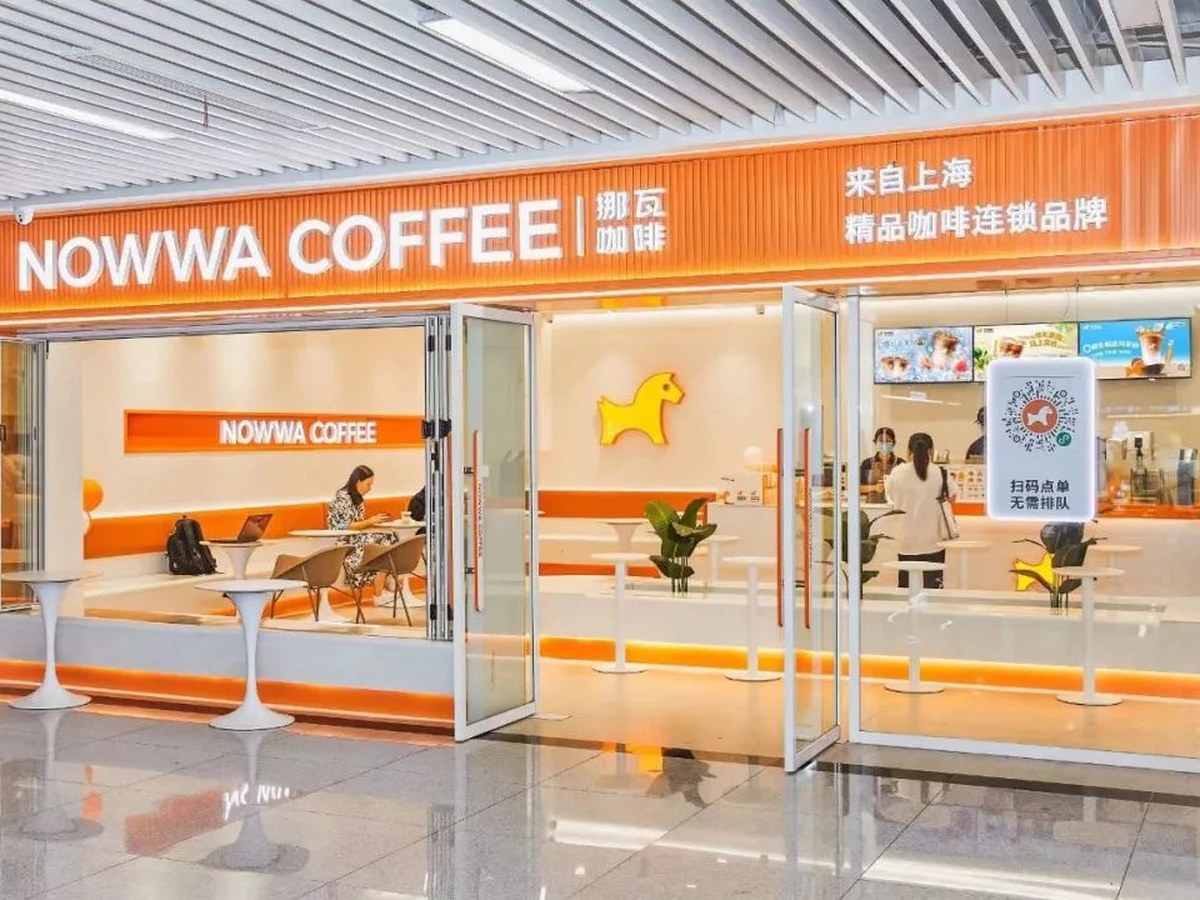
On 11 December 2025, Nowwa Coffee officially announced that its global store count had crossed 10,000. It became the fourth Chinese coffee chain to reach the figure, after Luckin, Cotti, and Xingyun. Total revenue for 2025, based on independent reporting by 36Kr, came in at RMB 700 to 800 million, approximately USD 102.8 to 117.4 million. Net profit was around RMB 60 million.
The store-count number is the headline. The revenue number is where the story is.
Most observers, looking at 10,000 stores, would assume revenue in the multi-billion RMB range. Luckin, by comparison, generates revenue per store that is many multiples higher. The gap exists because Nowwa is not really a coffee brand in the way Luckin is. It is a channel operator that happens to sell coffee. Nowwa partner Li Lixu confirmed publicly that approximately 80 percent of Nowwa outlets operate on a shop-in-shop model, with only 20 percent as standalone stores.
The shop-in-shop model is the entire story. A convenience store, internet cafe, gas station, or other host location provides the floor space and front-line staff. Nowwa provides the materials, the equipment, the brand, and the digital infrastructure. The host earns incremental revenue from coffee sales without committing capital to a separate retail operation. Nowwa earns margin on the ingredient supply without committing capital to the physical footprint. The capital efficiency is structurally different from anything the standard Chinese coffee narrative has accounted for.
Read what that does to the unit economics. A traditional Luckin or Cotti store requires real estate commitment, fitout capex, dedicated headcount, and standalone foot traffic. The break-even threshold for that store sits at a specific volume of cups per day. A Nowwa shop-in-shop installation requires none of that. The break-even threshold is essentially the cost of the equipment and the ingredient margin. The expansion pace is therefore decoupled from the financial constraints that limit how fast independent-format chains can grow.
This is the part the Chinese trade press has been pointing at and that few operators outside the category have properly absorbed. Nowwa did not win on coffee quality, brand strength, or store design. Nowwa won on a business model insight, which is that coffee can be a service category embedded into existing retail surfaces rather than a destination category that requires its own retail surfaces. Once that reframing is made, the question is no longer how fast you can build stores. It is how fast you can sign up host partners.
Convenience store chains in China have specific reasons to say yes. They do not have to invest in heavy assets. They get access to Nowwa's online traffic and ordering infrastructure, which is significant. For chains that already had marginal coffee operations of their own, the conversion produces order-of-magnitude improvements in throughput and profitability. Internal Nowwa reporting has cited five to ten times improvement in coffee sales volume at converted convenience stores, with 20 to 30 times improvement in net profit margin from the coffee category at those locations. Those are not marketing claims. Those are the conversion numbers that explain why the partner sign-up curve has been the steepest in Chinese coffee retail history.
There is a strategic cost. Nowwa partner Li Lixu has been candid about this. If the model is primarily about helping convenience stores earn extra money from coffee, Nowwa starts to look less like a consumer brand and more like a channel operator. The brand recognition Nowwa is building among end consumers is real but constrained. The customer who buys a Nowwa drink at a 7-Eleven counter forms a relationship with the convenience store, not the coffee brand. Brand equity accumulates more slowly than store count.
Quality control is the other weakness. Nowwa's ability to enforce consistency across 8,000-plus host partners who run their own primary operations is structurally weaker than a chain that owns its retail footprint. Some hosts will execute Nowwa's standards rigorously. Others will treat the coffee operation as a secondary line and let standards drift. The downside risk is reputational damage at the brand level when individual host locations underperform.
Both costs are accepted by Nowwa management as the tradeoff for the capital efficiency. The bet is that store-count-driven scale produces enough purchasing power, brand awareness, and operational data to eventually defend a position even if pure-brand competitors continue to outperform on per-store metrics.
The Editor's Note
If you are reading this and the pattern fits your business, start the conversation before the conversation starts itself. editor@unpublished.my.
Now bring this back to Malaysia, because Nowwa is arriving here in volume.
On 10 February 2026, VCI Global, the Nasdaq-listed Malaysian holding company, announced that its portfolio company Reveillon Group had signed a strategic cooperation deal to scale Nowwa to 200 Malaysian stores within three years. The announcement framed the deployment around Malaysia's USD 1.1 billion coffee market, which is growing at approximately 6.1 percent CAGR. Reveillon provides local execution. VCI Global provides the AI-enabled platform layer for site selection, consumer insights, and supply chain optimisation. Nowwa provides the brand, the playbook, and the supply infrastructure.
Read that deal structure carefully. Nowwa is not coming to Malaysia as a foreign chain trying to open 200 stores using its own capital and team. Nowwa is coming to Malaysia as a system that is being deployed by a local partner with access to local capital, local site networks, and local execution resources. The shop-in-shop logic that worked in China is being adapted to Malaysian convenience store chains, mamak shops, kopitiams, and other host environments that have foot traffic but currently underutilised coffee operations.
The Malaysian operator running an independent kopitiam, a mid-tier convenience chain, or a franchise coffee shop should be doing the strategic math on this immediately. The 200-store Malaysian deployment is targeting locations that already exist as host candidates. Some of those host candidates are the operator's direct competitors. Some are the operator's own locations that could be approached by Reveillon to host a Nowwa counter. The competitive dynamic over the next eighteen to twenty-four months is going to look very different from the conventional Starbucks-versus-ZUS-versus-Coffeebean framing that has dominated Malaysian coffee retail discussion.
There is also a structural lesson here that travels far beyond coffee. The category insight Nowwa exploited, which is that a product can be a service embedded into existing retail surfaces rather than requiring its own retail surfaces, applies to many other product categories that Malaysian operators currently run on the destination-retail model. Specialty teas. Boba. Healthy meal options. Snack categories. Pharmacy products. Beauty consumables. Pet supplies. The shop-in-shop model could rationalise the unit economics of any of these categories if the right host network and supply infrastructure can be assembled.
The bet Nowwa made and that VCI Global is now replicating in Malaysia is that the next phase of growth in Asian consumer categories will not come from building more standalone retail. It will come from densifying the product offer inside retail surfaces that already exist. The capital efficiency story is the same. The execution challenge is different but solvable. The competitive positioning advantage is enormous.
What this means for the Malaysian operator is specific. If you are currently running a destination format in a category that could plausibly be embedded, you should be assuming that the embedded version of your category is going to arrive in the next thirty-six months. The competitors who recognise this and either pivot to the embedded format or build defenses against it will outperform. The competitors who keep assuming that the destination format is the only viable format will find themselves losing share to operators they did not previously consider competitors.
Nowwa hit 10,000 stores because it understood something the conventional coffee chain narrative did not. The Malaysian market is about to find out whether the same understanding scales here. The operators who pay attention to what Nowwa is doing structurally, not just to which neighbourhoods get the new locations, will be the ones positioned to benefit from the shift instead of being caught by it.