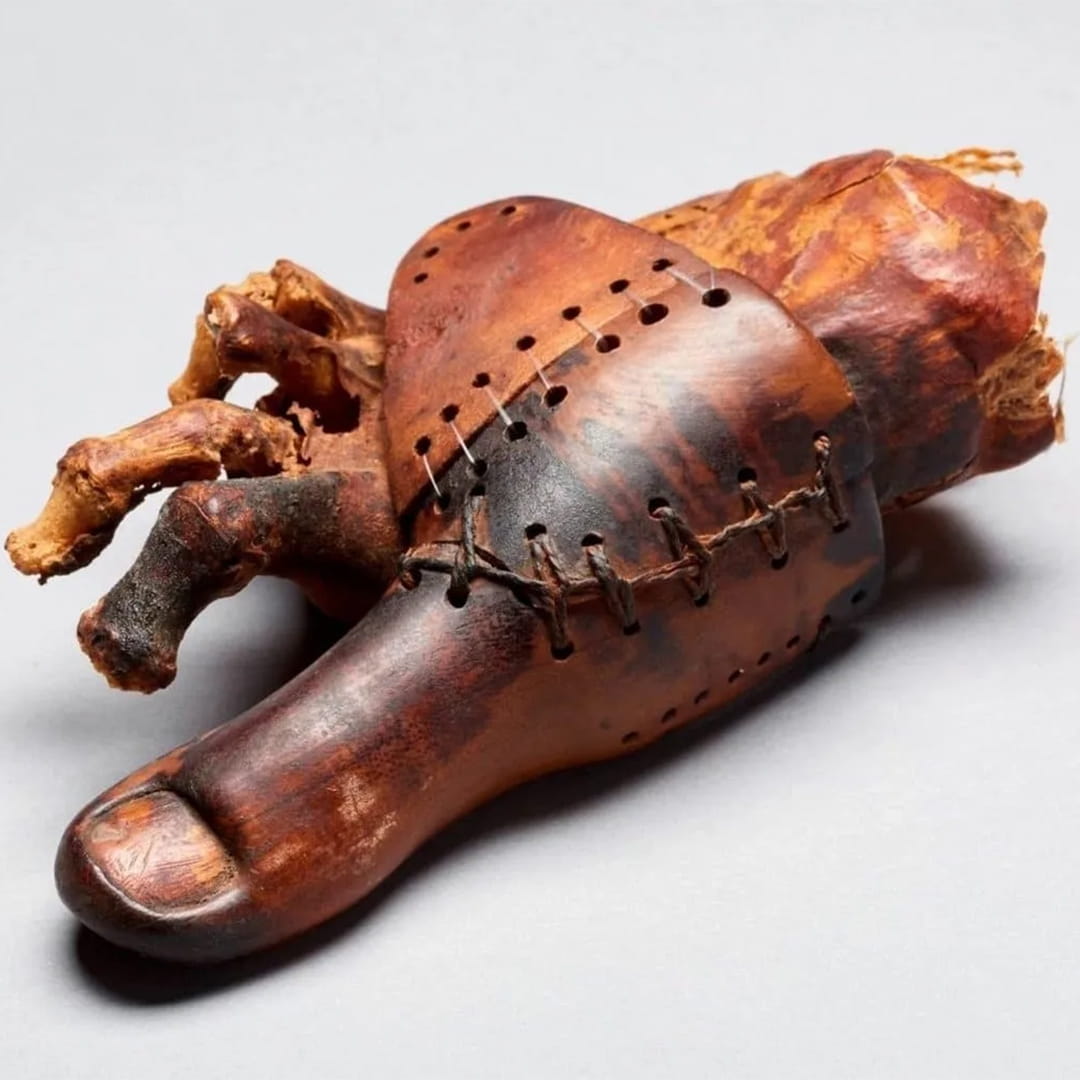
Around 1000 BC, an Egyptian priest's daughter named Tabaket-en-Mut lost her big toe. Archaeologists believe the cause was a complication of diabetes. There was no modern medicine. Someone, a craftsman, a physician, a relative, made her a prosthesis from three wooden segments joined together and wrapped in leather, fitted to the shape of her remaining foot. Three thousand years later, the artifact is in the Egypt Museum. It is one of the oldest known functional prosthetic body parts in the world. The medical historians call it the Cairo toe.
For most of the three millennia between Tabaket-en-Mut and 2026, the logic of replacement medicine has not changed. When a body part fails, you make a substitute, fit it, and hope the patient adapts. The materials evolved from wood and leather to titanium and silicone. The procedures became more sophisticated. The scope expanded from prosthetic limbs to organ transplants to electronic implants. The underlying logic remained the same. Replace what was lost. Restore function. Move on.
Something subtle but consequential has now changed in the framing. Two leading academic journals have published, within roughly twelve months of each other, papers that reframe replacement as something other than emergency rescue. Nature Aging ran Replacement as an Aging Intervention in May 2025, led by Sierra Lore with co-authors including Eric Verdin, George Church, Vadim Gladyshev, Anthony Atala, Morten Scheibye-Knudsen, and Jesse Poganik. Aging Cell followed in May 2026 with Replacement-Based Ageing Interventions for Systemic Rejuvenation, with a similar list of authors plus Alexander Zhavoronkov and Daniela Bakula. Together the two papers proposed that replacement is no longer the domain of surgeons handling acute failure. It is a candidate framework for managing aging itself, alongside drug-based therapies, device-based therapies, and regenerative medicine.
That framing matters because of what it implies about timing and scope. The traditional replacement market is structurally defined by acute events. A knee fails. A kidney shuts down. A heart attack damages cardiac tissue. The replacement market is reactive, episodic, and constrained by the timing of the failure event. The reframing as a longevity intervention implies a different market structure entirely. If replacement becomes a maintenance strategy rather than a rescue strategy, the addressable population shifts from the people who have already failed to the much larger population who would like to delay the failure. The market expands by an order of magnitude. The economics shift from emergency surgery pricing to ongoing health maintenance pricing. The competitive set widens to include longevity clinics, anti-aging platforms, and insurance-linked health programmes.
The signal that this reframing is moving from academic discourse into commercial activity came on May 15 of this year. United Therapeutics announced that the US Food and Drug Administration had cleared its investigational new drug application to begin a clinical study of UHeart, an investigational pig-derived heart engineered with ten gene edits. The trial will initially enroll up to two participants. The company plans to use the data to support a potential biologics license application if early results hold. Xenotransplantation has been an experimental field for decades. The FDA clearance is the moment the field moved into a formal regulatory pathway. The category is no longer aspirational. It is on a regulatory timeline.
The Editor's Note
If you are reading this and the pattern fits your business, start the conversation before the conversation starts itself. editor@unpublished.my.
The Singapore connection is the part the Malaysian operator should be reading most carefully. Immortal Dragons, a longevity technology fund based in Singapore, has concentrated its USD 40 million capital on four areas. Replacement-based aging intervention is one of the four. Gene therapy, reversal of neural aging, and acceleration of innovative therapies from research into clinical use are the other three. The fund has invested in more than twenty startups globally. The thesis, as articulated by the firm, is that aging is in part systemic hardware decline. Repair can help. Repair may not always keep pace. Replacing aged components could become a more efficient path to extending healthy life. The framework is the same as the academic reframing. The capital deployment is now real.
The portfolio reveals the operating logic. Frontier Bio, one of Immortal Dragons' investments, builds small-diameter vascular grafts prepared during surgery. Existing synthetic grafts perform poorly in small-diameter applications because blood comes into direct contact with artificial materials and forms clots. Traditional tissue-engineered blood vessels require cells to be cultured for weeks or months, a timeline most patients cannot accommodate. Frontier Bio's approach takes a small amount of adipose tissue from the patient's abdomen at the start of the operation, isolates the stem cells, and seeds them onto a biodegradable polymer scaffold on the operating table. Animal studies showed grafts integrating with host vessels within fourteen days. The product is autologous, living-cell, made-on-demand. No donor matching. No rejection risk. No long pre-operative culture period. That is the kind of capability that turns a one-time replacement into a procedure that can be deployed at scale.
Another portfolio company, ImmuneBridge, is working on bottlenecks in allogeneic cell therapy. The company's small molecule, IBR403, expands neonatal umbilical cord blood hematopoietic stem cells while maintaining their ability to differentiate into lymphoid and myeloid lineages. The downstream output is a young immune cell bank, NK cells, T cells, and B cells derived from a younger biological source than adult donor immunity. The strategic positioning is the part to study. ImmuneBridge is not building a single therapeutic. It is building the infrastructure that other therapeutics will plug into. That kind of platform play is the structure that produces compounding returns in healthcare. The first product validates the platform. The platform compounds value across every subsequent product that uses it.
The maturity hierarchy of the broader category is worth understanding because it tells the Malaysian operator where the commercial opportunities actually sit right now versus where they will sit five years from now. Tier one is thin-layer tissues, skin, cartilage, corneas. These have simple structures, do not require complex vascularisation, and are already commercialised. Apligraf and Epicel for skin. Vericel's MACI for knee cartilage. These products are industrialised. The growth story is incremental rather than transformational.
Tier two is hollow organs that have entered human clinical trials but are not yet at commercial scale. Bladders, urethras, vaginas. Anthony Atala's team published bladder engineering work in The Lancet in 2006, building new bladder tissue from a patient's own cells seeded onto biodegradable scaffolds and transplanted back. The work has progressed in the two decades since but is still pre-commercial. Tier two is where the next five years of investment will likely concentrate.
Tier three is solid organs, kidneys, livers, hearts. These require dozens of cell types, dense vascular networks, and complex metabolic functions. Most engineered solid organ products remain experimental. Solid organ replacement is the headline grabber. It is also the longest path to commercial scale. Reading the category requires distinguishing between the headline that drives the press cycle and the tier where the actual commercial activity is happening. The press cycle is dominated by xenotransplantation announcements. The commercial activity is dominated by tier one and tier two products.
China is the part of the regional context most Malaysian operators are underestimating. The National Healthcare Security Administration in China has created pricing items for medical 3D printing, including biological 3D printing of tissues, blood vessels, and organs. Hunan became the first province to issue local pricing rules. That regulatory readiness matters. A category with established reimbursement pricing has a defined commercial pathway. A category without reimbursement has to negotiate price point by point with each payer. Chinese xenotransplantation work has progressed in parallel. Xijing Hospital and Dou Kefeng's team at Air Force Medical University reportedly transplanted a six-gene-edited pig liver into a brain-dead human recipient in 2025, with the liver producing bile and albumin and being monitored over ten days. ClonOrgan, a Chinese biomedical pig breeding facility, operates approximately twenty-two hectares of facility and maintains roughly two thousand pigs. The ecosystem is being built, facilities, breeding stock, surgical teams, regulatory frameworks, payment systems, in parallel rather than sequentially.
Three obstacles will define what gets commercialised in the next five years versus what stays experimental. The first is vascularisation. Tissue-engineered constructs thicker than roughly one hundred to two hundred microns cannot deliver oxygen and nutrients to the interior without capillary networks. Thin-layer tissues bypass this. Solid organs cannot. Vascularisation is the central bottleneck for tier three. The second obstacle is immune rejection. Whether the replacement is a gene-edited pig organ, stem cells, or bioprinted tissue, the host body may treat it as foreign. Long-term immunosuppression increases infection risk and cancer risk. Chronic rejection remains difficult to eliminate. The third obstacle is age assimilation. Even when a young organ is successfully transplanted, the aged host environment, aged plasma, chronic inflammation, senescent cell signalling, can accelerate the transplanted tissue's deterioration. The science is unsettled on how meaningful that effect is for replacement medicine specifically, but the question is live.
For the Malaysian healthcare operator, four implications run from this story.
One. The structural shift from replacement-as-rescue to replacement-as-maintenance will redefine the addressable market for any Malaysian hospital, clinic, or insurer with longevity programmes in the planning phase. The current Malaysian healthcare conversation is dominated by tertiary care for acute conditions. The replacement-as-maintenance category sits in a category that does not currently exist in Malaysian health insurance taxonomy. The operators who help define that category in the local context, through pilot programmes, payer conversations, and regulatory engagement with the Ministry of Health, will set the terms for the next decade. The operators who wait will inherit the terms set by others.
Two. The Singapore fund concentration is the part that signals where regional capital is going next. Immortal Dragons is one fund. The thesis is portable. The capital pool dedicated to longevity in Southeast Asia is going to expand significantly over the next thirty-six months as family offices and sovereign-linked vehicles add longevity allocations. Malaysian operators with replacement-adjacent capabilities, tissue engineering laboratories, cell therapy facilities, biomaterials production, should be making themselves visible to that capital pool now. The fund managers who deploy first will define the relationships that compound. The Malaysian operators who present themselves credibly to the first wave of fund deployment will be the partners those funds work with on subsequent deployments.
Three. The regulatory pathway question is the strategic decision that will determine where regional commercialisation actually happens. China has built reimbursement pricing for 3D-printed biological tissues. Singapore has built a longevity-friendly regulatory environment with the Health Sciences Authority. Malaysia has not yet built either. The current default is that Malaysian patients seeking advanced replacement therapies will travel to Singapore, Bangkok, or Shanghai. The Malaysian Ministry of Health has a choice to make in the next twenty-four months about whether to build a competitive regulatory pathway for replacement medicine domestically or to cede the category to the regional capitals that have already built infrastructure. The decision the Ministry makes will determine whether Malaysian operators can build replacement-medicine businesses on home turf or whether they will be forced to operate primarily in foreign jurisdictions.
Four. The cultural and ethical conversation about replacement medicine is structurally different in the Malaysian and broader Islamic-majority Southeast Asian context than in the Chinese or Western context. Xenotransplantation involving porcine tissue, in particular, faces religious and cultural considerations in Malaysia and Indonesia that do not apply in the same way in other markets. The operators who engage with religious authorities, ethical councils, and patient communities early to map the acceptable and unacceptable categories of replacement will have a structurally cleaner commercial pathway than the operators who try to navigate those questions reactively after products are already on the market. JAKIM and similar bodies should be part of the strategic conversation now, not after the category has been defined elsewhere.
The Cairo toe sat in its tomb for three thousand years before archaeologists rediscovered it. The category it represents, humans making physical substitutes for failed body parts, was on a slow continuous progression that whole time. The progression accelerated through the twentieth century with kidney transplants in 1954, the first cardiac pacemaker in 1958, and hematopoietic stem cell transplantation maturing through the 1990s. The progression is now accelerating again, on a new framing. Replacement medicine is no longer rescuing the body from acute failure. It is being positioned as a strategy for maintaining the body before failure occurs. The Malaysian healthcare operator who positions early for that reframing will be operating in a category that, twenty years from now, will look in retrospect to have been obviously the right place to be. It does not look obvious right now. That is the point.
The headline is a Singapore fund deploying capital into replacement biology. The story is the next thirty years of regional healthcare strategy being quietly redefined while most Malaysian operators are still budgeting around the old framing. The Malaysian operator reading the press release version is reading the wrong version.