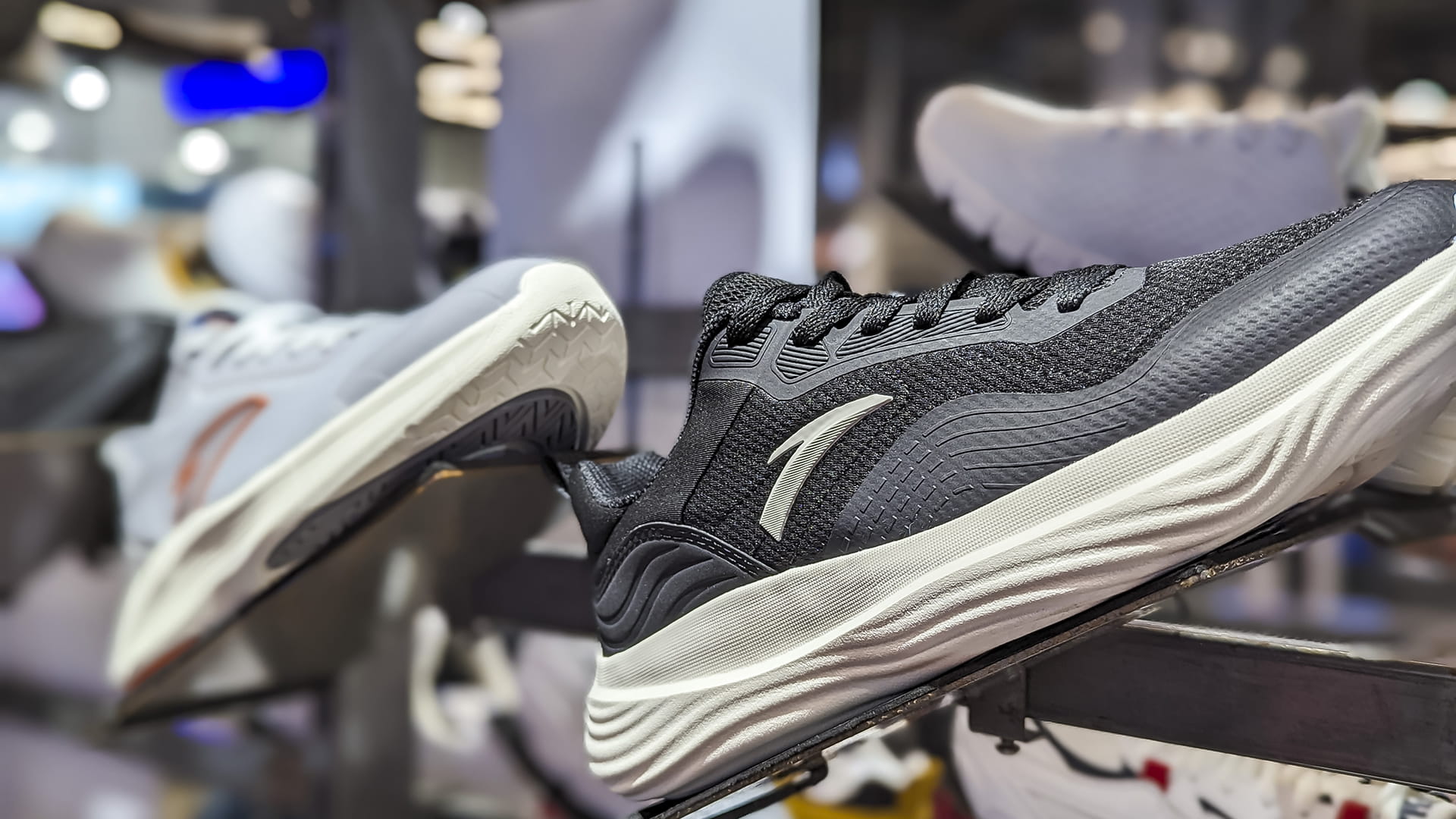
The Anta flagship store opened in Beverly Hills in February. The address sits between Lululemon and Wilson on a ritzy boulevard. NBA stars Kyrie Irving and Klay Thompson, the latter newly signed to a lifetime deal with the brand, drew long queues at the grand opening. Attendees ate matcha popcorn inside. The aesthetics were calibrated to read as a confident global player rather than a foreign brand from China trying to break into the West. That calibration is the cover story.
The 35-year-old company is now the world's third largest sportswear maker by revenue. Only Nike and Adidas sit higher. Anta posted USD 11.8 billion in 2025 revenue, up 13.3 percent. The headline number is impressive. The breakdown of where that growth came from is the part that should be read carefully. The core Anta label, the mass-market Chinese sportswear brand that built the company, grew only 3.7 percent in 2025. The diverse portfolio of acquired brands grew 59.2 percent. Read those two numbers together. The growth engine is no longer the founding brand. The growth engine is the portfolio Anta has assembled around it.
The portfolio is the strategic apparatus. In January, Anta announced it would acquire a 29 percent stake in struggling German sportswear maker Puma for EUR 1.5 billion, equivalent to USD 1.7 billion. Puma's shares have gained 60 percent since the deal was announced, with investors betting that Anta's distribution network in China will revive a brand that lost its way in its home market. That bet is grounded in evidence. Anta did exactly this with Fila. From 2019 to 2021, Fila accounted for nearly half of Anta's profits, after Anta repositioned the South Korean-owned brand with Italian heritage as a sports fashion play in China. The Puma deal is not speculative. It is the Fila playbook applied to a much larger brand.
Then there is Amer Sports, the Finnish conglomerate Anta led a consortium to acquire in 2019. That consortium included the family office of Lululemon founder Chip Wilson and Asian private equity firm FountainVest Partners. The acquisition gave Anta access to a long list of premium outdoor brands including Arc'teryx and Salomon. Amer Sports has become a growth engine in its own right, with shares up 173 percent since its January 2024 Nasdaq listing. Walk through Shanghai or Shenzhen and the Arc'teryx waterproof shells and Salomon trekking shoes have become status symbols on fashion-conscious consumers. Brands that read in the West as outdoor performance gear were repositioned in China as urban lifestyle markers, and the repositioning produced a step-change in revenue.
The execution model is the part that other Asian operators should be studying. Anta takes controlling stakes but allows acquired brands operational independence. Local managers run China operations with significant autonomy from headquarters. The brands retain their original visual identity, retail positioning, and marketing language. What changes is the distribution intensity, the product localisation, and the access to Chinese channel infrastructure that no Western brand can build from scratch. This is the inversion of the classic acquisition playbook, where the acquirer imposes its standards on the acquired and homogenises the portfolio. Anta does the opposite. The portfolio is deliberately heterogeneous because the heterogeneity is the point.
The Editor's Note
If you are reading this and the pattern fits your business, start the conversation before the conversation starts itself. editor@unpublished.my.
The competitive backdrop is the second piece of the puzzle. Nike's China business has suffered six consecutive quarters of sales declines. The company has publicly warned of a long road ahead to regain ground. A Jefferies report from February captured why. Nike's consumer group in China is increasingly overlapping with the consumer groups of Li-Ning and Anta. The premium Western brand and the value-domestic brands are now competing for the same customer. The mid-tier where Nike historically dominated has been hollowed out from both ends. Li-Ning's Stephen Curry partnership, signed last year, signals the same thing from the value side that Anta's Kyrie Irving signing signals from the global side. Both brands are saying they will compete on talent and on category positioning, not just on price.
The pricing comparison is sharp. The Anta KAI 3 basketball collection with Kyrie Irving retails at USD 135 a pair. The Nike LeBron collection with LeBron James sells for USD 210 to 235. The gap is not a small discount. It is roughly a 40 percent price differential on flagship product. Consultancy Roland Berger's Shanghai partner Kathy Jiang told Nikkei that sportswear buyers are warming to local labels because they offer "better value for money," which she described as a significant shift. Euromonitor's senior analyst Tian Lan pushed the framing further. The Chinese sportswear market can no longer be described as a binary competition between domestic and international brands. The competition is now about which operators can respond fastest to evolving consumer preferences, local culture, and lifestyle-driven demand. Nationality is becoming irrelevant to the category dynamics.
The Chinese domestic context is the third piece. Official data valued China's sports industry at over RMB 3.8 trillion, equivalent to USD 559.4 billion, at the end of 2024. The government expects that figure to double by 2030. China's sportswear market is projected to reach USD 66.3 billion by 2027, growing at 4.2 percent annually, faster than the global average of 2 percent and the Asia-Pacific average of 4 percent. Sports consumption is one of the few bright spots in a Chinese consumer economy that has otherwise been struggling with weak domestic demand. Anta is the structural beneficiary of that anomaly, while also positioning itself to be the structural beneficiary of the next phase of category growth in the developed markets that Beverly Hills is meant to signal.
For the Malaysian and broader Southeast Asian operator, four implications run directly from this story.
One. The Anta playbook is the export-ready model that Chinese consumer brands are now generalising across categories. Last month, Shein announced it would acquire Everlane, a US retailer best known for ethical sourcing positioning. Earlier this year, Centurium Capital, the private equity firm backing Luckin Coffee, acquired Blue Bottle Coffee, the US specialty roaster. Read those three deals together. Anta-Puma, Shein-Everlane, Luckin-Centurium-Blue Bottle. The Chinese consumer category is no longer trying to brute-force its own brands into Western markets. It is buying credible Western brands with established consumer trust and applying Chinese operational scale to them. Every Malaysian consumer brand operator should be asking whether their category has a Chinese acquirer-in-waiting and what that acquirer would value about their position.
Two. The K-shaped sportswear market that analysts now describe in China is a model for what is coming to every Asian consumer category. Successful brands either occupy the mid-to-high tier with professionalism and design, or the value-for-money segment. The middle is being eliminated. Anta captures both ends, with its premium international brands serving the high end and its home label positioned as mid-tier among domestic mass-market brands. The 2023 acquisition of a 75 percent stake in Maia Active, a yoga apparel brand competing directly with Lululemon at a fraction of the price, is the value-end play designed to occupy the position Lululemon cannot defend. Malaysian operators positioned in the eliminated middle of any consumer category should be reading this as a warning. The middle is structurally where margin disappears.
Three. Regional expansion is in Anta's plans, and Malaysia is on the map. Anta plans to open 1,000 points of sale across Southeast Asia by 2028. The annual report references active e-commerce expansion in the region. The competitive pressure that has reshaped the Chinese sportswear market is going to arrive in Kuala Lumpur, Jakarta, and Manila over the next 36 months. Local sportswear retailers, multi-brand stores, and adjacent athleisure operators should be modelling what their category looks like when Anta and Li-Ning have a thousand combined points of presence in the region, with the brand portfolio and pricing flexibility that the Chinese parent operators have demonstrated at home.
Four. The Beverly Hills flagship is not where Anta makes its money. It is where Anta announces what kind of company it intends to be next. The store will lose money in absolute terms for years. The brand equity it builds at the high end of the global market will support the next acquisition. The next acquisition will fund the one after. The playbook compounds. Every Malaysian consumer brand that has been talking about international expansion as a future ambition should be reading the Anta sequence as the demonstration that international expansion through acquisition can be a self-funding cycle if the underlying domestic base is large enough to support it. Malaysia's domestic base is not as large as China's. The implication is not that Malaysian brands cannot run this playbook. The implication is that they have to be far more selective about the acquisitions they attempt.
The headline is a Chinese brand reaching the global sportswear podium. The story is the operational template that Chinese consumer brands have now standardised for converting domestic scale into global category position. The Malaysian operator reading the press release version of this story is reading it incorrectly. The version worth reading is the one that maps every acquisition Anta has made, identifies the playbook, and asks which Malaysian consumer category is most exposed to having that playbook turned on it next.
The answer to that question is the briefing your strategy team should be writing this week.