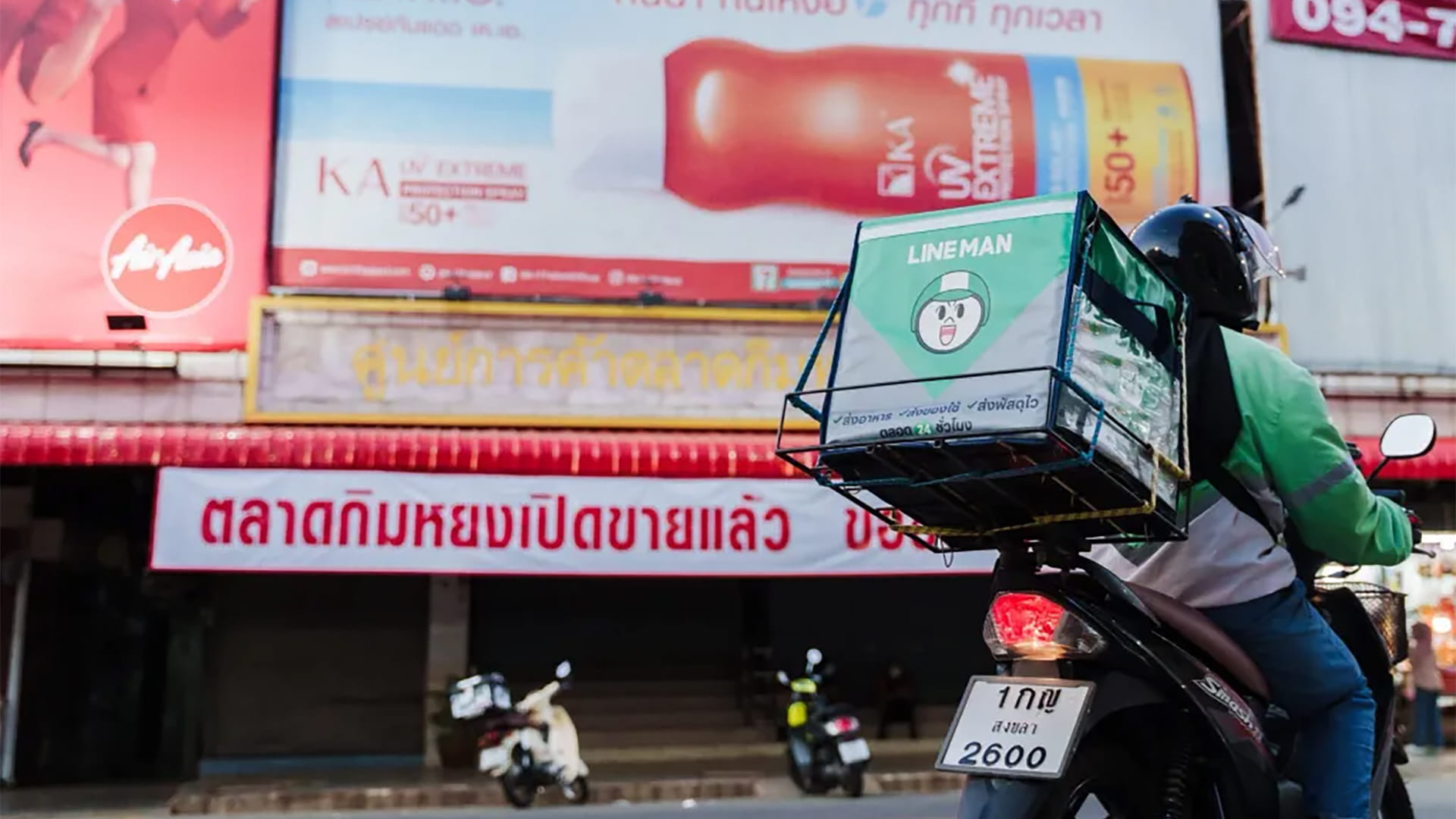
Yod Chinsupakul, the CEO of Line Man, sat down with Nikkei Asia and confirmed three things that will reshape the Southeast Asian food delivery competitive map over the next three years. The IPO target is 2027. The deadline is hard. The proceeds will be used to fight the price war, invest in artificial intelligence, and pursue acquisitions. The fourth confirmation is the one that most regional operators are not reading carefully enough. Line Man does not plan to expand outside Thailand.
Read that fourth point again. The CEO of a regional category leader with a clear path to public markets and access to Japanese parent capital from LY Corporation, the operator of the Line messaging app, has explicitly chosen to stay inside one market. That decision is the actual cover story. The numerical metrics, the IPO timing, the AI investment plans, those are the easy press lines. The decision to refuse the obvious expansion playbook is the strategic move that deserves the most attention.
Start with the market position itself. According to Singapore-based consultancy Momentum Works, Line Man held a 41 percent share of the Thai food delivery market in 2025, measured by gross merchandise value. The number was 20 percent in 2020. The category grew while Line Man captured share. Grab still leads with 47 percent. Foodpanda, the third major player, retreated and withdrew from Thailand. Line Man is now the clear domestic challenger to Grab, with about ten million active monthly users in a country of about 70 million. That is roughly one in seven Thais using the platform every month. The 700,000 restaurants on the platform is the harder number, because that is the supply-side moat that becomes structurally difficult for a new entrant to replicate.
The financial position is mixed. Revenue for 2024 was THB 16.7 billion, equivalent to USD 512 million, up 44 percent from 2023. That growth rate is the kind of number that builds an IPO story. The net loss for the same year was THB 356 million, or USD 10.9 million. The company is unprofitable but losing comparatively little relative to its scale and category position. That is the correct profile for a regional category leader heading to public markets. The numbers say credible IPO candidate, not desperate fundraising.
The corporate ownership structure is the part that should be read most carefully. Line Man is a consolidated subsidiary of LY Corporation, the Tokyo-listed parent of the Line messaging app. The IPO venue is being finalised by the third quarter of 2026, with Hong Kong, Singapore, Nasdaq, and the Stock Exchange of Thailand all under active consideration. The LY parent has explicitly told Nikkei that nothing has been decided about selling part of its Line Man stake at IPO. That ambiguity is informative. It tells you the parent is keeping optionality, which is what a strategic parent does when the subsidiary is approaching its inflection point but the parent has not yet decided whether to lock in liquidity or hold for further appreciation. Either decision is defensible, which is why the parent has not signalled which one it will make.
The Editor's Note
If you are reading this and the pattern fits your business — start the conversation before the conversation starts itself. editor@unpublished.my.
Now the strategic decision that is the actual cover story. Yod's framing of the refusal to expand internationally is sharp. The strategy right now is to go deeper into Thailand rather than to expand internationally. The reasoning is that the company knows the Thai market well, will optimise its technology, and will localise as it understands each community. Read that against Grab's playbook for the past decade, which has been geographic expansion across Southeast Asia, plus vertical expansion into financial services, mobility, and on-demand services. Line Man is doing only the second half. Vertical expansion within Thailand, refusing the geographic expansion. That is a deliberate, public, executive-level inversion of the dominant regional platform strategy.
The execution of the vertical expansion is already visible. The 2020 merger with Wongnai, a Thai restaurant review site, gave Line Man both the supply-side relationships and the user data that food delivery on its own would have required years to accumulate. The 2024 acquisition of Jera Cloud added 1,700 beauty clinic, wellness centre, and spa partners to the platform, taking Line Man out of food delivery into the broader services category. Line Pay integration handles payments. Point-of-sale software keeps the restaurant relationship stable. Telepharmacy launched early in 2026, with pharmacist consultation and medicine delivery embedded into the app. Each of these moves is a category that Grab has also entered or attempted, but Line Man is doing them only inside Thailand, with deeper integration than Grab can match in any single market because Grab has to be many things across many countries.
That is the strategic bet. A regional generalist serving eight or nine markets cannot integrate as deeply as a domestic specialist serving one. Line Man is making the case that depth beats breadth in a market that is rich enough to support a fully integrated platform. Thailand has 70 million people, the largest food delivery growth rate in the region at 22 percent in 2025, a strong consumer culture around dining, and government policies like Khon La Khrueng that explicitly subsidise consumption on local platforms. The macroeconomic context is harder, with household debt and rising fuel prices from the US-Iran war creating pressure, but Yod is explicit that the harder economy is helping food delivery rather than hurting it, because consumers are choosing affordable home meals over restaurant dining.
For the Malaysian and broader Southeast Asian regional platform operator, three implications run from this.
One. The regional generalist model is going to face structural pressure from domestic specialists in each market that has reached scale and density. Thailand has reached that point first. Indonesia will reach it next. The Philippines, Vietnam, and Malaysia are further along the curve than they were three years ago but are not yet at Thailand's density. The dominant assumption in regional platform strategy has been that the region is one market that should be served by a regional player. Line Man's strategy assumes the opposite. The region is many markets, each rich enough to support deeply integrated domestic platforms that out-localise the regional player on the things that matter most to consumers in each market. If Line Man is right, Grab's regional advantage erodes country by country as each market produces its own Line Man equivalent.
Two. The IPO venue choice is going to be strategically informative. Hong Kong, Singapore, Nasdaq, and Stock Exchange of Thailand are all under consideration. Each venue tells a different story about who Line Man wants to be seen by. Hong Kong gives access to mainland Chinese capital and signals an Asian regional play despite the domestic-only operating strategy. Singapore signals the same regional ASEAN positioning that Grab and Sea have used, which is interesting because Line Man is explicitly not following that strategy. Nasdaq gives the highest valuation multiples but the highest reporting burden and the most distance from the operating market. Stock Exchange of Thailand is the cleanest fit with the operating strategy but the smallest investor base and the lowest multiples. The decision will reveal what kind of valuation Line Man and LY think the domestic-only thesis can support, and at which kind of investor.
Three. The AI investment line in the IPO use of proceeds is the part most likely to be underestimated by external observers. Line Man has hired more than fifty AI engineers. The first product is an AI helper for restaurants to create photos, write menu descriptions, and generate product descriptions. That product sounds small. It is not. The merchant-side AI tools are the structural lever that converts Line Man's restaurant relationships from a transactional supply-side network into a platform that the merchant cannot operationally separate from. Once a restaurant is running its menu, photos, descriptions, and increasingly its inventory and operational decisions on Line Man's AI tools, the cost of switching to Grab is no longer a few weeks of operational disruption. It is a fundamental rebuild of the restaurant's digital operations. That is the moat Line Man is building, and it is a category that Grab will have to match across eight or nine markets simultaneously to defend its existing position.
The cut-rate price war that Yod acknowledged will continue is the part that public market investors will focus on. Both Grab and Line Man use discounting strategies to defend share. Both strategies compress margins. Both will produce slim profit margins for the foreseeable future. That is correct as a financial concern. But it is also a misreading of where the real competitive battle is being decided. Price war is the surface. Merchant lock-in through integrated AI tools and platform services is the actual structural decision being made. The company that wins the structural decision can withdraw from the price war when the time is right. The company that loses the structural decision cannot, regardless of how much capital it has.
The headline is a 2027 IPO. The story is a regional category leader explicitly betting that depth-in-one-market beats breadth-across-many. Whether that bet works for Line Man specifically will be one of the more informative competitive experiments of the next three years. The Malaysian platform operator reading this story should be asking whether the same bet, made by a Malaysian domestic specialist, could displace Grab from Malaysia the same way Line Man has displaced Foodpanda from Thailand. The answer is yes, structurally. The harder question is whether any Malaysian operator is positioned to make that bet at the scale required.
That question is the one that is going to define Malaysian platform strategy for the next three years.