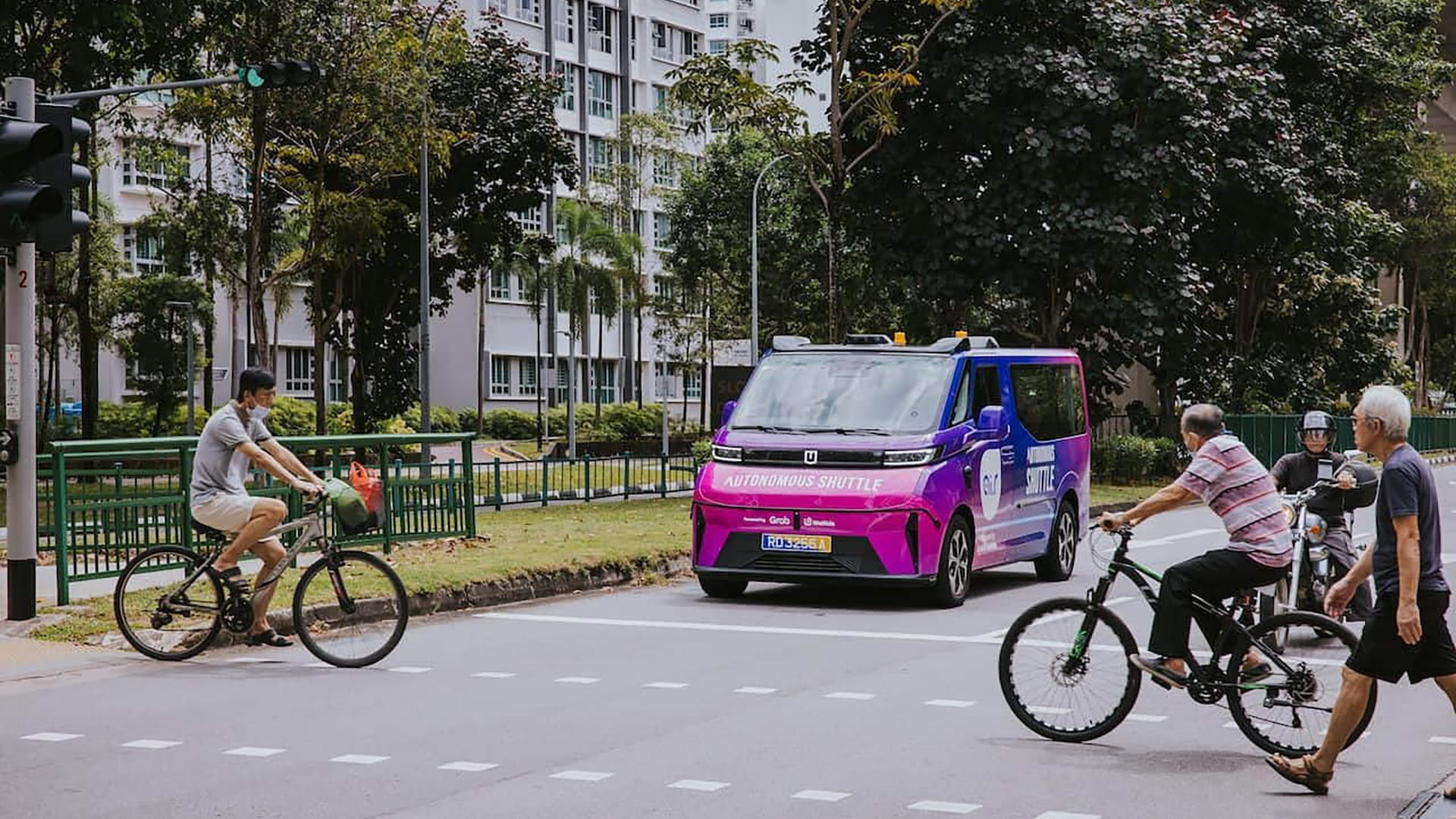
On the morning of June 22, Sun Xueling, Singapore's senior minister of state for transport, appeared at a pickup point in Punggol. The occasion was not a ribbon cutting for a train station or a bus interchange. It was a chat with residents who had signed up to ride a free driverless shuttle operated by ComfortDelGro, the country's largest taxi company. The shuttle, painted a distinctive bluish purple with the words "autonomous shuttle" running along its sides, runs a seven-kilometer route through the northern residential district in twenty-five minutes, with three designated pickup and dropoff points. A few hundred people had signed up on that first day. Passengers can book through the ComfortDelGro app. The service is currently reserved for groups, families, and those requiring assistance. A ComfortDelGro employee sits in the driver's seat to monitor the vehicle and take the wheel if necessary. The technology is Level 3, which the industry defines as allowing drivers to take their hands off the wheel and eyes off the road under certain conditions.
The details underneath the launch matter more than the launch itself. The autonomous system is powered by Pony.ai, a Toyota-backed Chinese startup that has become one of the region's most consequential autonomous driving technology providers. ComfortDelGro ran invitation-only trials in April in the same Punggol area, serving 1,500 passengers before opening the shuttle to public booking. The company's group CEO, Cheng Siak Kian, told the local business press earlier this year that ComfortDelGro is aiming to convert about ten percent of its fleet to robotaxis over the next four to five years. Ten percent of the ComfortDelGro fleet is not a pilot programme. It is a strategic conversion of the largest taxi operator in the country. The company's June 22 press release contained the line that summarises what has actually changed. Autonomous mobility is no longer a distant ambition. The company is integrating technology, infrastructure, and the operational know-how needed to deploy autonomous vehicle services safely and at scale. Read the line again. That is not an aspiration. That is a schedule.
Grab, the ride-hailing group that operates across Southeast Asia including Malaysia, has been running the parallel programme. Grab began an invitation-only trial in January and has offered free public rides since April in partnership with WeRide, the Chinese autonomous driving company. Grab has served more than five thousand passengers on the free service and is targeting a commercial launch later this year. The Grab operation is the one Malaysian operators should be studying most carefully, because Grab operates across the region and its Singapore deployment is the reference architecture for what a Grab commercial launch in Kuala Lumpur, Bangkok, Jakarta, or Manila will look like once the regulatory environment aligns. The Singapore proof of concept is not for Singapore. It is for the region.
The trial has not been perfect. During January testing, a ComfortDelGro autonomous vehicle collided with a road divider. No passengers were on board. No injuries were reported. The company paused trials for two weeks for safety checks and resumed. That incident is important precisely because it happened, was disclosed, was investigated, and did not derail the programme. The regulatory environment in Singapore treated the collision as an expected part of a supervised trial, not as evidence that autonomous mobility was not ready. That regulatory posture is the structural asset the Singapore transport regulator has been building over the past decade. The Land Transport Authority, the Ministry of Transport, and the various sovereign-linked vehicles have coordinated across three consecutive government terms to build the frameworks that let a driverless vehicle collide with a road divider, pause for safety review, and resume without ending the programme.
The Editor's Note
If you are reading this and the pattern fits your business, start the conversation before the conversation starts itself. editor@unpublished.my.
The bus programme is the piece most Malaysian analysts are underestimating. The Ministry of Transport is moving forward with the rollout of autonomous vehicles, with self-driving buses set to offer pilot service on two public routes in Marina Bay in the second half of the year. The Land Transport Authority will initially buy six autonomous buses to run alongside the existing service during a three-year trial. Six buses is not a demonstration. Six buses is the smallest unit of a public transport line integrated into the timetable of the country's national transport network. If those six buses run reliably for the three-year trial, the follow-on procurement is measured in hundreds, not in dozens. Public transport procurement is one of the most durable government commitments an autonomous mobility supplier can secure, because it is embedded in national infrastructure planning cycles that outlast individual political administrations.
The regional read is what makes the Singapore programme strategically consequential rather than locally interesting. Every ASEAN transport regulator is now watching two things simultaneously. First, whether the Singapore deployment scales without a major safety incident that would end the political runway. Second, what commercial terms Singapore extracts from the Chinese autonomous driving technology providers. Both variables will be read as precedents for what the rest of the region should target when Chinese providers approach Bangkok, Jakarta, Kuala Lumpur, Manila, and Ho Chi Minh City. The commercial terms are the more consequential of the two. Singapore's negotiating position, backed by state ownership stakes in ComfortDelGro, existing sovereign investment relationships with Grab, and a regulatory framework that Chinese providers have publicly said they want to operate under, is stronger than any other ASEAN transport regulator's position by an order of magnitude. The terms Singapore locks in with Pony.ai and WeRide will be the reference terms that Malaysian, Thai, Indonesian, Philippine, and Vietnamese regulators try to match, and mostly fail to match, over the next three to five years.
OCBC analyst Ada Lim framed the current state precisely. ComfortDelGro is building future capabilities, although its autonomous vehicle fleet and AI-based fleet management remain in a relatively nascent stage. The word nascent is doing important work in that sentence. A nascent capability inside an operator that plans to convert ten percent of its fleet within four to five years is a nascent capability that is going to be mature in a very short window. The Malaysian transport operator who is watching ComfortDelGro's current state and reading it as still-not-ready is reading the wrong variable. The right variable is the trajectory. The trajectory has ComfortDelGro operating a materially autonomous fleet by 2030 at the latest.
For the Malaysian and broader Southeast Asian operator, four implications run from this story.
One. The Grab-WeRide partnership is the direct precedent for what will happen in Malaysia within the next twenty-four to thirty-six months. Grab's Singapore deployment is not a Singapore-specific arrangement. It is the pilot that produces the operational data, the safety record, and the regulatory relationships that Grab will use to negotiate similar deployments across the region. Malaysian transport regulators, Ministry of Transport officials, and the various state-linked mobility investors should be evaluating now what terms they want to attach to a Grab-WeRide equivalent deployment in the Klang Valley, Penang, or Iskandar. The default of waiting for Grab to propose specific terms produces terms shaped by Grab. The alternative of defining the desired terms in advance, publicly, in coordination with Prasarana and the Ministry of Transport, produces terms shaped by Malaysian strategic priorities.
Two. The Prasarana question is the one Malaysian policy needs to answer explicitly. Singapore's public autonomous mobility programme is being led by ComfortDelGro (a listed operator with government-linked ownership) and by the LTA (a statutory board). Malaysia's equivalent structure would place Prasarana at the centre of any Malaysian public autonomous mobility programme. Prasarana currently operates LRT, MRT, monorail, and the RapidKL bus network. The strategic decision facing Prasarana over the next thirty-six months is whether to position as the deploying jurisdiction (buying autonomous vehicles from Chinese technology providers and integrating them into existing public transport) or as the operating platform (building Malaysian capability in fleet operations, dispatch, and vehicle customisation on top of the Chinese autonomous technology). The two positions produce different downstream economics by an order of magnitude. Prasarana's board and the Ministry of Transport should be making this decision explicitly in 2026, not by default in 2028.
Three. The commercial terms Singapore extracts from Pony.ai and WeRide are the reference terms Malaysia should be targeting. Specifically, the data sovereignty terms (who owns the driving data generated by autonomous fleets operating in Singapore), the technology transfer terms (whether Chinese providers commit to training Singaporean engineers and building capabilities that transfer to local operators), and the exclusivity terms (whether the initial partners get category exclusivity or whether Singapore preserves the ability to license multiple providers) are all going to be worked out in Singapore first. The Malaysian government's negotiating position for the equivalent terms is materially weaker than Singapore's because Malaysia does not have the sovereign wealth position, the regulatory reputation, or the concentration of state-linked mobility operators that Singapore has. The Malaysian counter-strategy is coordination with other ASEAN transport regulators to negotiate as a bloc. Individually, Kuala Lumpur is a small market. Collectively, ASEAN represents a market too large for Chinese autonomous mobility providers to ignore. The coordinated position is more valuable than the individual position, and building that coordination is the diplomatic work that needs to happen now.
Four. The workforce transition is the political variable most likely to shape whether the Malaysian rollout succeeds or stalls. ComfortDelGro's June 22 press release included the language on driverless services being expected to complement its human driver workforce, help alleviate chronic driver shortages, and create opportunities for employees to move into future-ready roles. That framing is deliberate. Singapore has a driver shortage. Autonomous vehicles are being positioned as filling the shortage, not as replacing existing drivers. Malaysia does not have a driver shortage in the same way. Malaysian taxi drivers, Grab drivers, and public transport operators are a politically consequential workforce whose displacement by autonomous vehicles would produce meaningful political friction. The Malaysian government and the Malaysian transport operators need to have the workforce transition strategy defined before the technology deployment reaches critical mass, not after. Singapore has the structural advantage of a labour shortage that makes the transition politically easier. Malaysia does not. That structural difference should shape the Malaysian rollout strategy more than most operators are currently pricing.
The headline is a free driverless shuttle in a Singapore residential neighbourhood. The story is the deliberate construction of the reference ASEAN autonomous mobility deployment, negotiated with Chinese technology providers on Singapore's terms, over a rollout schedule that positions the city-state as the regional benchmark. The Malaysian transport operator who reads the press release version is reading the wrong version. The right version asks which side of Singapore's precedents Malaysia wants to be operating on when the equivalent overtures land in Kuala Lumpur, and what the Ministry of Transport, Prasarana, and the Malaysian mobility investors need to decide in the next twelve months to make sure the answer is a strategic answer rather than a reactive one.