The most important sentence in Pony.ai's London announcement is the one it did not write. On 8 October, the Chinese autonomous driving company said in a post on X that it would begin testing its seventh-generation robotaxis on London roads within weeks, as Britain moves ahead with self-driving trials under what Pony.ai described as the country's frontier plan. Uber will put the cars on its app when a service opens. What the announcement left out was who will own the cars. Neither company has said. TechCrunch reported that London is expected to follow the model already running in Zagreb, and in Zagreb, neither Pony.ai nor Uber owns the fleet at all.
That omission is the story. Read quickly, the headline says a Chinese technology company has landed in a G7 capital. Read slowly, it says the robotaxi industry has worked out that it does not want to own robotaxis. For a decade the sector argued about sensors, software and safety cases. The harder problem was always capital. Somebody has to buy thousands of vehicles, insure them, charge them, clean them at two in the morning, replace a cracked windscreen and keep a depot staffed. Earlier this year Pony.ai's chief executive James Peng told the trade press that the real limit on robotaxi scale is exactly this layer of invisible errands. London is the answer Pony.ai has settled on: hand those errands to someone who wants them.
The template is Zagreb. In August, Pony.ai and Uber expanded their partnership into a plan to deploy more than 2,000 robotaxis across five European cities. The Croatian capital went first, and Pony.ai calls it Europe's first commercial robotaxi service. Riders can book through Uber or through the app of Verne, the Croatian mobility company that owns and operates the fleet and leads the regulatory approvals. TechCrunch and The Next Web identify Verne as the startup founded by Mate Rimac, the electric hypercar entrepreneur. Pony.ai supplies its Gen-7 driving system and the Arcfox Alpha T5 vehicle it developed with BAIC. Uber supplies the demand and has agreed to invest in Verne. Coverage spans central Zagreb and the airport. The first rides launched about a week after the August announcement, with a safety driver on board.
The reason for splitting the business this way sits in Pony.ai's own numbers. Its robotaxi fleet passed 1,700 vehicles at the end of May, and the company raised its year-end target from 3,000 to more than 3,500. Revenue for the first quarter of 2026 was USD 34.3 million, up 145 percent year-on-year, and robotaxi service revenue nearly quintupled to USD 8.6 million. The net loss for the same quarter widened to USD 53.5 million. A company losing roughly fifty million dollars a quarter does not also buy fleets in five European cities. What it can do is drive down the cost of the hardware until somebody else's arithmetic works. Pony.ai is targeting a bill of materials below RMB 230,000, about USD 33,900, for its Gen-7 vehicle by mid-2027, and it says it has already reached per-vehicle breakeven in Guangzhou and Shenzhen. Co-building fleets is a warm phrase. Read it the way a finance director would: Pony.ai sells the brain, Uber rents the customer, and the partner carries the depreciation.
The Editor's Note
If you are reading this and the pattern fits your business, start the conversation before the conversation starts itself. editor@unpublished.my.
London was not chosen for its weather. It is one of the largest urban transport markets in Europe, and Britain has done something most countries have not: it answered the liability question before the cars scaled. The Automated Vehicles Act, passed in 2024, creates a category called the authorised self-driving entity, which carries legal responsibility when the vehicle is in control of the steering. Full implementation is expected in 2027, but the Department for Transport brought forward a licensing framework for automated passenger services to spring 2026, which allows earlier pilots of driverless taxi services. A clear rule on who pays after a crash is not a legal footnote. It is what lets an insurer price a policy and a fleet owner price a lease. Without it, the Verne role does not exist.
The result is that London has become the most crowded robotaxi test track in Europe. In August, Transport for London licensed several of Wayve's camera-based Ford Mustang Mach-E vehicles as private hire cars, completing what operators call the triple lock of operator, driver and vehicle licences. Uber launched rides with Wayve in September, with a trained safety driver in every car, after more than 100,000 Londoners joined its waitlist in eight weeks. Waymo has been testing roughly 100 Jaguar I-Pace vehicles in the city since March and is aiming for a fully driverless commercial launch in the fourth quarter with Moove as fleet operator. Baidu began testing Apollo Go RT6 vehicles in July with Lyft and FreeNow, and expects its first passengers by 2027. Uber and Waymo work together in Phoenix, Austin and Atlanta. In London they will compete.
Look at that list again and a pattern appears. Waymo has Moove. Pony.ai has Verne in Zagreb and an undisclosed partner in London. Uber has deals with more than 30 autonomous vehicle companies and expects to offer self-driving trips in up to 15 cities worldwide by the end of 2026. On 2 September it told staff it would cut about 3,300 roles, roughly ten percent of its workforce, to fund an autonomous push that includes more than USD 10 billion in partnerships. Uber is turning itself into an aggregator of other people's robots. The technology companies are turning themselves into licensors. In between, a new kind of business is forming: the fleet operator, a company that owns cars it does not design and serves riders it does not acquire.
There is also a geography lesson. The United States has moved to bar Chinese connected-vehicle software from its roads. Britain and continental Europe, so far, have not. For Chinese autonomous driving companies, Europe is becoming the large rich market that remains open, and they are entering it the way Chinese electric vehicle makers did: through partners, local assembly of trust and a willingness to let someone else hold the customer. Pony.ai runs robotaxi services in four Chinese cities and has projects at different stages in the UAE, Singapore and South Korea. Its rival WeRide says it is present in a dozen countries. The Chinese robotaxi export is not arriving as one big launch. It is arriving city by city, through whoever is willing to own the cars.
For Malaysia, the distance between this story and home is shorter than it looks. No robotaxi service operates here, even though Malaysia is Grab's largest market, and there is not yet a framework that allows a driverless vehicle to carry a paying passenger. The building blocks are arriving in a different order. In June the Transport Ministry granted the country's first Level 4 public-road permit, to logistics firms Zelos and ALS under the National Autonomous Vehicle Regulatory Sandbox, a story we covered at the time. In July Malaysia opened its first autonomous vehicle control centre in Cyberjaya to oversee a 22km test route. Across the causeway, Grab and WeRide began a fixed-route autonomous service in Punggol in April, with an operator on board, in the same estate where free driverless shuttle rides began earlier this year. Three implications follow.
One. Liability before licences. Britain's sequence matters more than its speed. It decided who is responsible when a self-driving car is in control, then opened the permit window. Malaysia's sandbox answers the question of whether a vehicle can drive on a public road. It does not yet answer who pays when a passenger is hurt. Until that is settled in law, no insurer will price a robotaxi fleet properly, and no serious owner will finance one. The policy work that unlocks this market is not more test routes. It is a liability rule.
Two. The fleet-owner seat is open, and it suits Malaysian capital. Look at the economics of the Verne role without the glamour. It is an asset-heavy business with a supplier for the technology, a platform for the demand and long-life equipment to finance and maintain. That is close to a concession: a toll road, an independent power producer, a bus depot. Malaysia built a generation of listed companies on exactly that shape of business. Vehicle rental and leasing groups, bus operators and transport arms of state-linked groups already own depots, maintenance teams and fleet financing lines. When a Chinese technology supplier and a ride-hailing platform come looking for a local owner, the Malaysian company that has already studied Zagreb will have the stronger hand.
Three. Design the driver transition before the cars arrive. Uber sold its Southeast Asian business to Grab in 2018, and Grab has since partnered WeRide and backed US robotaxi operator May Mobility. E-hailing supports hundreds of thousands of Malaysian livelihoods. Every European launch in this story starts with a human safety driver, then moves to remote supervision, depot technicians and fleet controllers. Those are jobs, and they can be filled by people who drive for a living today, if someone builds the retraining path now. If nobody does, the arrival of driverless cars will be argued as a jobs crisis rather than planned as a jobs transition.
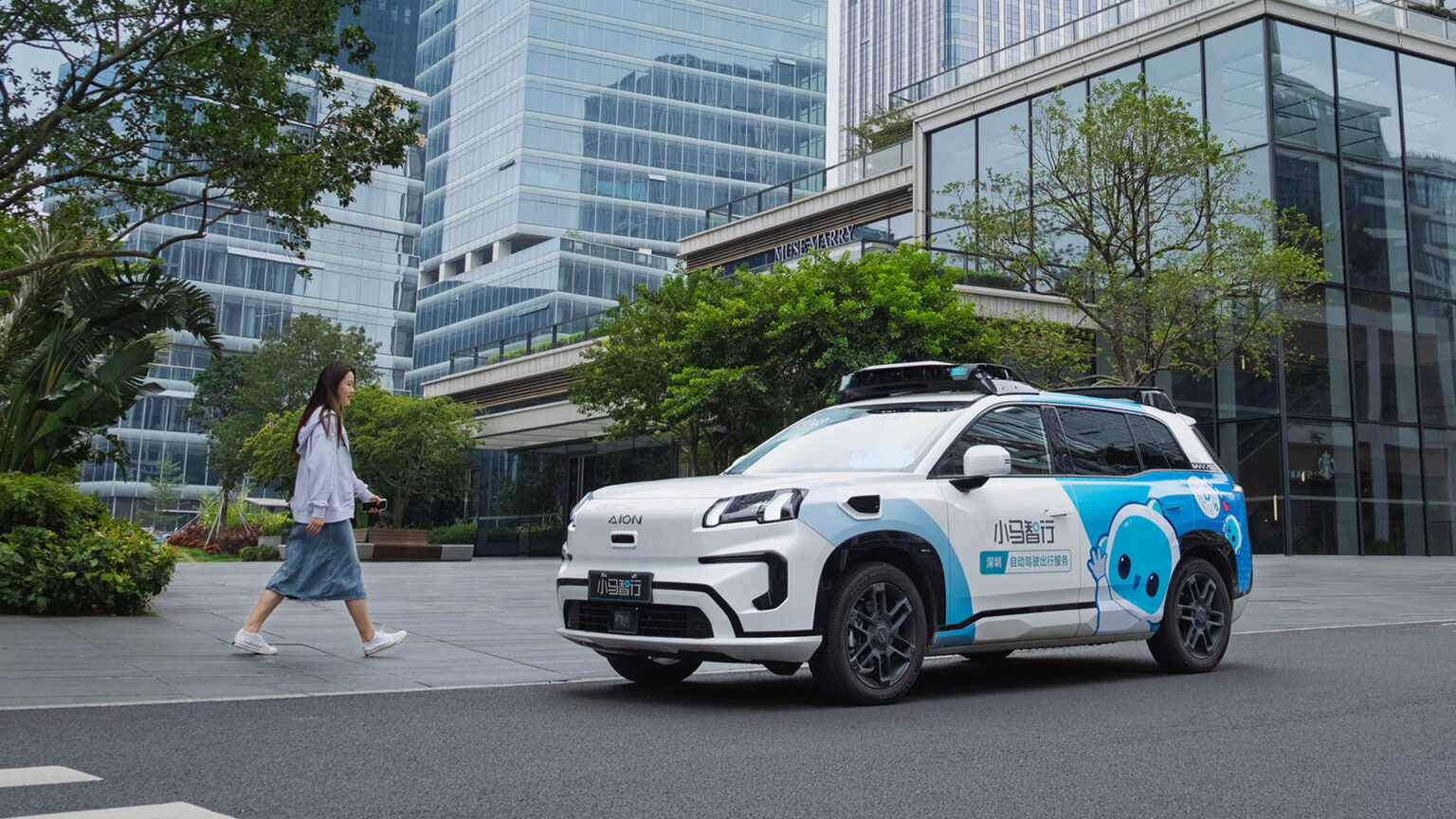
The car in our photograph is a Pony.ai robotaxi on a Shenzhen street. In a few weeks a cousin of it will be learning the roundabouts of London. The headline says a Chinese robotaxi is going to Britain. The business underneath says the companies that build robotaxis have decided they would rather not own them. Whoever in Kuala Lumpur understands that first gets to.